|
3/7/2024 0 Comments Logging Algonquin DocumentaryRegister for this free documentary screening (Wed, Mar 20, 7-9 pm EDT) and support the call to protect old growth forest in Algonquin Park. The panel discussion is inclusive of past Chief of Pikwakanagan First Nation/author Kirby Whiteduck and Lynn Gehl PhD (Algonquin). Limited Space; Sign up ASAP. Eventbrite link: https://www.eventbrite.ca/e/logging-algonquin-online-screening-and-discussion-tickets-857302493837 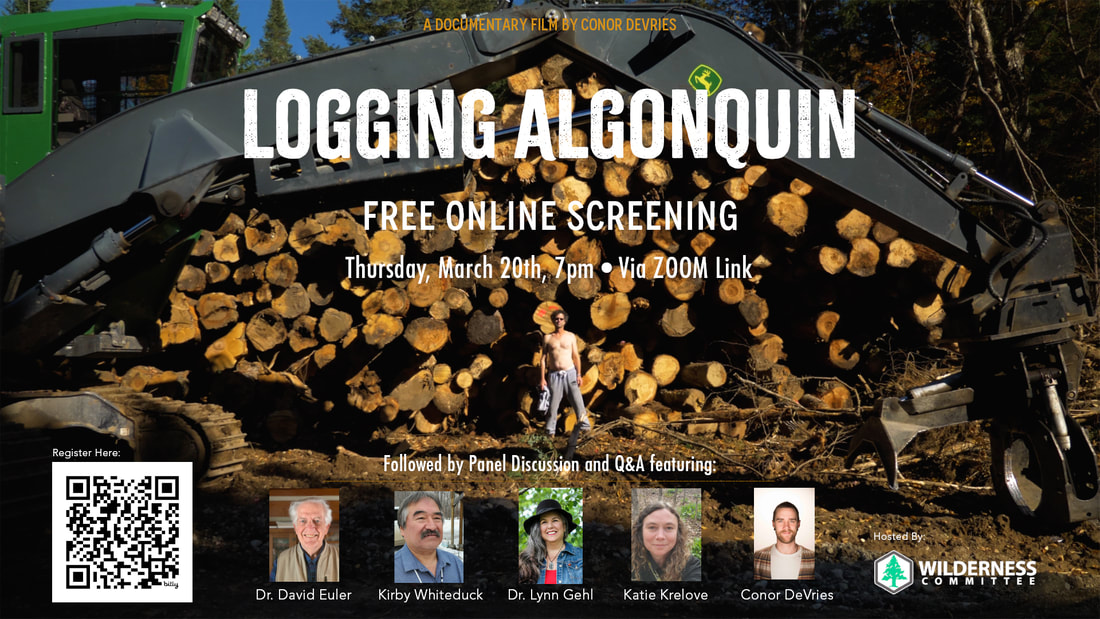
0 Comments
 Indigenous ambassadors of the nuclear system fail to walk it back to Creation Without any doubt the nuclear industry is blasphemy to the Sacred Pipe Without any doubt the nuclear industry is blasphemy to the Four Sacred Elements: Water, Rock, Wind, Fire Without any doubt the nuclear industry is blasphemy to the Four Orders of Creation: the Four Sacred Elements, the Plant and Tree Nations, the Animal Nations, Human beings It is within our human metaphysical belief systems where our very beliefs of morality are embodied Once embodied through teachings, ritual, and ceremony the purpose of the metaphysical moral system remains intact and anchored in its place where subsequently when humans create new inventions they then walk them back to the knowledge inherent Without any doubt the nuclear industry is blasphemy to all the Anishinaabeg: stand for sing for dance for pray for Don’t be a failed human being Walk it back to Creation and reason (mind) Walk it back to Creation and feel (heart) Debwewin AuthorLynn is an author, advocate, artist, and public speaker. Her work encompasses both anti-colonial work and the celebration of Indigenous knowledge. She challenges Canada’s practices, policies, and laws of colonial genocide such as the land claims and self-government process, sex-discrimination in the Indian Act, the continued destruction of Akikpautik / Chaudière Falls–an Anishinaabeg sacred place, and Canada’s lack of policy addressing Indigenous women and girls with disabilities who are bigger targets of sexual violence.  This blog is part of a more than two-decade long running analysis of the Ontario Algonquin land claims process. Additional works can be found in Anishinabek News, rabble, ricochet, Policy Options, and Briarpatch Magazine. I am dedicated to this knowledge production of exposing Canada’s long term ongoing denial of who the Algonquin are because its parliament illegally squats on Algonquin land yet it is a little-known reality. I see it as my role to shine a light on Canada’s best kept secret, preventing it from hiding in plain sight. In offering this analysis of the recent Algonquins of Ontario (AOO) Tribunal results I do not claim to offer an absolute Truth. See: https://rabble.ca/indigenous/heart-break-algonquin-genocide/ https://ricochet.media/en/318/first-nations-finance-their-own-demise-through-land-claims-process https://policyoptions.irpp.org/magazines/november-2016/deeply-flawed-process-around-algonquin-land-claim-agreement/ The AOO, the corporation established for the Algonquin land claims process with the colonial governments of Canada and Ontario, and best known as a process of extinguishment, have been operating through a corrupted enrollment process. Although past Chief Kirby Whiteduck has stated several times that enrollment does not equate with being a beneficiary to the final settlement, enrollment has provided non-Algonquin people a role in shaping the outcome of the Agreement-in-Principal (AIP) by way of voting in electing Algonquin Negotiation Representatives (ANRs) who sit at the table along side Pikwakanagan First Nation (Pik FN) chief and council members, and in terms of voting rights during the ratification of the 2016 AIP. The number of eligible voters in 2016 was 7,694. This number is not inclusive of all registered status Algonquin. See: https://www.strikezonetackle.com/mattawanorthbayalgonquinfirstnation/Mar%2017%202016%20AOO%20AIP%20Ratification%20Results_Spreadsheet_20160317_Final%20%281%29.pdf For decades enrollment has been an issue for legitimate Algonquin. Members of Pik FN have become victims of a tyranny of false enrollment and falsely created communities whereby the seven-member chief and council of Pik FN has held less votes than the nine primarily non-status groups. I offer the discourse of ‘legitimate on the ground communities’ because Pik FN is the only community where Algonquin share the same roads, stores, health centre, recreational centre, administrative buildings, and struggles such as poverty, addiction, and unemployment. Essentially, Pik FN is the only collective sharing the same land, water, and air. Although it is well known that there was a history of colonial denial of other Algonquin collectives, the descendants of these other collectives have existed within well established municipal structures, and have so for some time. This is not the same as the situation that Pik FN members find themselves situated within. While Algonquin may be equal, they are differently equal. Clearly some require a deeper understanding of equality – it does not mean erase difference. In terms of addressing false enrollment, it was in 1999 when Kirby Whiteduck addressed the inclusion of Thomas Lagarde dit St. Jean as an ancestor, and thus all of his descendants. Years later in 2013 Clifford Meness, a council member for Pik FN, also addressed this same historic person. Their efforts were unsuccessful due to the production of fraudulent document/s. A recent 2021 CBC investigation involving historical, archival, and hand writing analyses exposed these documents as fraudulent. See: https://www.cbc.ca/news/canada/saskatchewan/letter-lagarde-algonquin-1.6121432; https://www.cbc.ca/news/canada/saskatchewan/algonquin-ancestry-lagarde-letter-follow-1.6171830; https://www.cbc.ca/news/canada/saskatchewan/algonquin-ancestry-report-not-verified-1.6680772 In February 2022, Dr. Darryl Leroux offered an analysis of the Schedule of Ancestors which lists 78 root ancestors. Relying on a race-shifting lens he identified six Algonquin women born in the 1600s, five non-Algonquin Indigenous people born in the late 1700 and early 1800s, and a smaller number of French Canadians who should be removed. See: www.youtube.com/watch?v=9LiXdg3dW24 See also: www.youtube.com/watch?v=FxRsC-Yzs-I&ab_channel=MSUDepartmentofEnglish Following, in 2022/3 an Algonquin Tribunal was established whereby 14 historic persons on the Schedule of Algonquin Ancestors were adjudicated to determine if they, and subsequently all of their descendant, met the test of Algonquin-ness. Interestingly, these historic persons did not include the six Algonquin women Leroux identified (again born in the 1600s), yet this list does expand to additional historic persons. The definition of Algonquin-ness being: Is the named person identified in a historic record or document dated on or before December 31, 1921, in such a way that it would be reasonable to conclude that he was considered to be an Algonquin or Nipissing, or a sibling of such a person. A ‘sibling of such a person’ means a person with a common Algonquin parent. The Tribunal also stated that if a historic person fails to meet the criteria eligibility, it “may affect your eligibility to be on the Enrolment List and, as a result, your eligibility to vote in ANR elections, vote on the ratification of the Treaty and, ultimately, be a beneficiary of the Treaty”. Of the historic persons, half or seven failed: 1. Angelique Atkinson ‒ Pass 2. Frederick Ferris and Walter Ferris ‒ Fail* 3. Sophie Emelie Jamme dite Carriere ‒ Fail 4. Jacques Kamiskwabininch ‒ Pass 5. Francois Kawitadijik ‒ Pass 6. Thomas Lagarde dit St. Jean ‒ Fail 7. Toussaint Laronde ‒ Pass 8. Hannah Mannell ‒ Fail 9. Michel McDonald ‒ Fail* 10. Anna McDonald-McDonnell ‒ Pass 11. Cecile McDonnell-Mawiskak ‒ Fail* 12. Louis Michiminanakwakwe ‒ Pass 13. Joseph Paquette ‒ Fail 14. Mary Petrin ‒ Pass See: https://www.tanakiwin.com/tribunal/
With this outcome, it motivates the question, “How many descendants rely on these non-Algonquin in the AOO process?” Relying on the 2015 Final Voters’ List (2015 Final Voters’ List) as my data source, using the find function, the following numbers were generated (search terms in quotations): 1. Frederick Ferris and son Walter Ferris: 213 rely on “Frederick Ferris” 2. Sophie Emelie Jamme dite Carriere: 1,256 rely on “Sophie Emilie Carriere” 3. Thomas Lagarde dit St. Jean: 1,255 rely on “Thomas St. Jean dit Laguarde” 4. Hannah Mannell: 102 rely on “Hannah Mannell” 5. Michel McDonald: 34 rely on “Michel McDonald” 6. Cecile McDonnell-Mawiskak: 314 rely on “Cecile Mawiskak McDonnell” 7. Joseph Paquette/Paquett/Payette: Not found on 2015 Voters’ List In thinking about what these findings mean in terms of the number of the voters on the 2015 Final Voters’ List, we need to appreciate that some people rely on two or more of these historic persons. Thus we cannot simply add the numbers and generate a total number. For example many, if not most, enrollees who rely on Sophie Emilie Carriere also rely on Thomas St. Jean dit Laguarde, as they were married. In moving on, all AOO enrollees who rely on Hannah Mannell have no other person listed as an ancestor, this also applies to all enrollees who rely on Michel McDonald. The same, though, cannot be said of the enrollees who rely on Cecile Mawiskak McDonnell; of the 314 enrollees only twelve rely on her solely, meaning that some of her descendants have a historic person who passes the test of Algonquin-ness. Further, Joseph “Paquette/Paquett/Payette” is not found in the 2015 Final Voters’ List and so I am unable to generate a number of enrollees in my thinking process. Lastly, while Federick Ferris fails, his son Walter is married to Anna McDonald-McDonnell who passes the test, meaning Walter’s descendants will remain enrolled. These caveats demonstrates that a method of determining the precise number of people who should not have been enrolled in the AOO process, and who should not have voted in the AIP ratification process is difficult to precisely determine. With this explained, in looking at the numbers and considering that some enrollees rely on two or more historic persons, and relying on the 2015 Final Voters’ List as my data base, it is my best ‘estimate-guestimate’ that approximately 2,000 people will be removed from the AOO process. In actuality, these 2,000 people should never have been allowed to shape the AOO process in any capacity what-so-ever. It is also useful to recall that in 2013 retired Judge Chadwick made a decision removing 700 AOO enrollees, most coming from the Sharbot Lake and Ardoch regions. Further to this in 2019 when seeking to still the waters of its membership over enrollment issues, Pik FN leadership stated 2,500 people had already been removed from enrollment. One can assume that the 700 people from the 2013 process are included in this number. See: https://www.frontenacnews.ca/central-frontenac-news/item/478-potts-drops-bombshell-on-sharbot-lake-algonquins Disturbingly, two ANRs, Connie Mielke of the so-called Algonquins of Greater Golden Lake First Nation and Lynne Clouthier of the so-called Ottawa Algonquin First Nation, now disqualified as Algonquin through this Tribunal sat at the AOO table for some time, as a matter of fact they generated a healthy salary (70K) in this ANR position. Their removal from the AOO process is now reflected on the updated AOO website; their profiles have been deleted. See: https://www.tanakiwin.com/algonquins-of-ontario/algonquin-negotiation-representatives/ Thus, contrary to what past Chief Wendy Jocko once stated, not all AOO enrollees were/are “real Algonquin”. While some people think the issue is a status versus non-status issue, this is incorrect. The bigger was/is an infestation of pretendians, or as Dr. Veldon Coburn has argued, it was more in line with intentional “sabotage”. See: https://www.youtube.com/watch?v=ISnqaNHJ1vw&ab_channel=AlgonquinsofPikwakanaganFirstNation See: https://www.youtube.com/watch?v=sixcgn4iIh0&ab_channel=APTNNews In summary, beginning with Kirby Whiteduck’s effort in 1999, and Clifford Meness’ effort in 2013, and now through this recent Tribunal it is my estimate that as many as 4,500 non-Algonquin have been removed from the process; and the matter of the Algonquin women born in the 1600s remains to be addressed. * While it was determined that three of the historic persons did not fulfil the criteria of "Algonquin", it was understood that they are Indigenous: 1. "There is no question that Cecile Mcdonnell-Mawiskak (RIN #14687) is a woman of Indigenous ancestry." See: https://www.tanakiwin.com/wp-system/uploads/2023/07/Algonquin-Tribunal-Determination-and-Reason-regarding-McDonnell-Mawiskak-RIN-14687-dated-2023-07-18.pdf 2. "All members of the Tribunal recognize and agree that Frederick Ferris (RIN #5208) and Walter Ferris (RIN #2196) were both Indigenous people and, hence, his descendants are of Indigenous ancestry." See: https://www.tanakiwin.com/wp-system/uploads/2023/08/Algonquin-Tribunal-Determination-and-Reasons-regarding-Frederick-and-Walter-Ferris-2023-08-04.pdf 3. "All members of the Tribunal recognize and agree that Michel McDonald (RIN #14703) was an Indigenous person and, hence, his descendants are of Indigenous ancestry." See: https://www.tanakiwin.com/wp-system/uploads/2023/08/Algonquin-Tribunal-Determination-and-Reasons-regarding-Michel-McDonald-RIN-14703-dated-04-08-2023.pdf AuthorLynn is an author, advocate, artist, and public speaker. Her work encompasses both anti-colonial work and the celebration of Indigenous knowledge. She challenges Canada’s practices, policies, and laws of colonial genocide such as the land claims and self-government process, sex-discrimination in the Indian Act, the continued destruction of Akikpautik / Chaudière Falls–an Anishinaabeg sacred place, and Canada’s lack of policy addressing Indigenous women and girls with disabilities who are bigger targets of sexual violence. On December 1st, 2023 Pikwàkanagàn First Nation Chief and Council has declared a State of Emergency, and as such the leadership is seeking support. Canadians, new settlers, and descendants of settler people can help. First though, Pikwàkanagàn First Nation is the closest First Nation to Canada’s capital region. As a matter of fact, through Canada’s processes of genocide which include legislative and policy manifestations, denying Algonquin their very own land and resources while at the same time offering free land grants to settler people, Canada parliament buildings, supreme court, governor general’s residence, and the majority of its national museums all illegally squat on Algonquin territory. Here are three actions that you can take today: 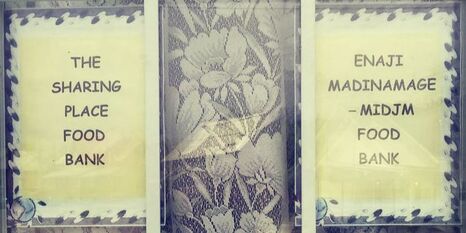 1. Donate to the Enaji Madinamage - MIDJM/The Sharing Place Food Bank. This food bank serves the Pikwàkanagàn First Nation community as well as the surrounding area of Golden Lake. https://www.canadahelps.org/en/charities/enaji-madinamage-midjmthe-sharing-place-food-bank/  2. Donate to Omamiwinini Pimadjwowin: The Algonquin Way of Life Cultural Centre. One goal this initiative has is building a new Cultural Centre and Museum - a place to share Algonquin culture, traditions, language, and art forms are honoured and celebrated. This capital project is said to require $5 million dollars. https://www.canadahelps.org/en/charities/omamiwinini-pimadjwowin-algonquin-way-of-life/  3. The Truth and Reconciliation Commission forgot to mention the need for people to decolonize their Last Will and Testaments and their final obituary. Do you live, work, or recreate on Algonquin land? If so, consider gifting an element of your final estate back to the Algonquin. You can donate to the charities above, or you can contact the First Nation directly. You can also ask family and friends to ‘in lieu of flowers’ donate to the Algonquin Anishinaabe. https://www.algonquinsofpikwakanagan.com/  Lynn is an author, advocate, artist, and public speaker. Her work encompasses both anti-colonial work and the celebration of Indigenous knowledge. She challenges Canada’s practices, policies, and laws of colonial genocide such as the land claims and self-government process, sex-discrimination in the Indian Act, the continued destruction of Akikpautik / Chaudière Falls–an Anishinaabeg sacred place, and Canada’s lack of policy addressing Indigenous women and girls with disabilities who are bigger targets of sexual violence.
© All Rights Reserved 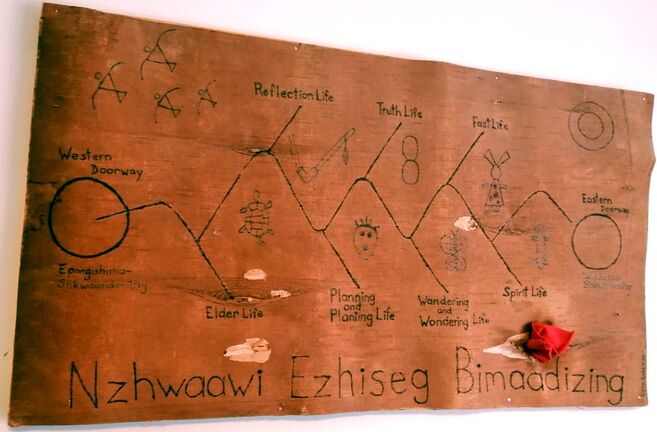 The Seven Stages of Life Birchbark Scroll. Art and photograph copyright Lynn Gehl (2013), Algonquin. On December 1st, 2023 Pikwàkanagàn First Nation Chief and Council declared a State of Emergency, and as such the leadership is seeking support. Some community members are stepping up offering meals, and fundraising activities. That said, I want to put this out there . . . As many people know my grandmother and her parents were escorted out of their reserve community in the early 1930s. And most people know that I have been on a long journey seeking understanding, and ascribing meaning to the history of my family misery. In my thirties I learned how to read and write eventually gaining a doctorate. I also travelled through Canada's court system to restore Indian status registration to my great grandmother's and great grandfather's descendants, and many other Indigenous people across Canada. I won Gehl v Canada and I am now a proud "reinstated" Algonquin member of Pikwàkanagàn First Nation. Along this learning process I encountered many discussions of the role of heart knowledge and the role of mind knowledge when coming to Debwewin (a personal truth). Too many Indigenous people embody heart knowledge without a mindful understanding what Canada did to their ancestors. And this thwarts their forward motion in life. I personally found deep meaning, and thus constructive agency in moving forward, in learning Algonquin culture, history, and wisdom. In essence Indigenous knowledge saved my life. 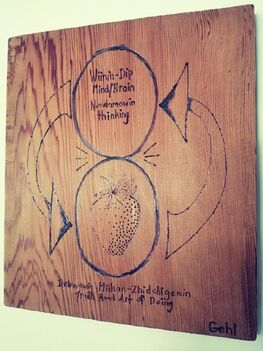 Debwewin Miikan-Zhidchigewin Scroll. Art and photograph copyright Lynn Gehl (2013), Algonquin. Debwewin Miikan-Zhidchigewin Scroll. Art and photograph copyright Lynn Gehl (2013), Algonquin. Along this process of coming to know, navigating the oppressive power of racism, sexism, ableism, white saviourism, and pretendianism, I eventually came to a place of valuing the incredible profoundness of "Debwewin Miikan-Zhidchigewin", an ancient and traditional Anishinaabe teaching that asks individuals to firmly situate themselves at the core of their knowing process, their truth, and also their own journey of coming to wellness; essentially to harness their spirit-agency within in moving through the seven stages of life. I pulled the profoundness of Debwewin Miikan-Zhidchigewin from several threads such as Anishinaabe language speakers, elders, listening deeply, a Midewiwin practitioner, the literature, difficult emotions and feeling, and from ancient scroll knowledge - and so rest assured it is distinctly Anishinaabe knowledge and wisdom. As Pikwàkanagàn First Nation Chief and Council members, leaders, thinkers, elders, and traditional people ponder what can be done to help our community members - I want to offer a group teaching of this most profound teaching: Debwewin Miikan-Zhidchigewin. I have to do something versus nothing. But I cannot do it by myself. There would have to be community and leadership support and their attendance and participation (inclusive of heathy and wise people), a wellness team to stand behind it, and additional resources as needed. Further, participants would have to have their minds clean of all substances, and their hearts would have to be open to deep learning and deep feeling. I can be reached at lynngehl@gmail.com or through www.lynngehl.com  Lynn is an author, advocate, artist, and public speaker. Her work encompasses both anti-colonial work and the celebration of Indigenous knowledge. She challenges Canada’s practices, policies, and laws of colonial genocide such as the land claims and self-government process, sex-discrimination in the Indian Act, the continued destruction of Akikpautik / Chaudière Falls–an Anishinaabeg sacred place, and Canada’s lack of policy addressing Indigenous women and girls with disabilities who are bigger targets of sexual violence. © All Rights Reserved Kwey Kwey, Many people are not aware that Indigenous women and girls with disabilities are bigger targets of sexual violence because they cannot hear, see, walk, or run. As a matter of fact some women and girls are not able to speak up or scream that they are being, or have experienced, the trauma of a sexual assault. One of the barriers I have in raising awareness about this matter is that people make assumptions and/or repel when I use the word "disability". Sadly many elders and traditionalists themselves are a barrier to my process of raising awareness because they prefer to rest on the traditional teaching that children have "gifts" that we nurture; we do not talk about disabilities. While it is true that traditionally we talk about people and their gifts, the reality is that due to a lack of land, clean land, clear air, clear water, and due to poor sewage, poor housing, and poor nutrition the Indigenous body has been landscaped with a higher rate of disabilities. See #IWagWid for more information. That said, I once again created an online auction to better serve #IWagWid, and I need your help. I am asking you to join the auction asap, invite your friends through the invite button asap, and bid on the many items. I will be using the funds raised to offer a public talk on the relationship between land loss and the higher rate of disabilities. Awareness is the first step toward change. I need your help with this. Here is the link: https://www.facebook.com/groups/711242806601128 Chi-Miigwetch 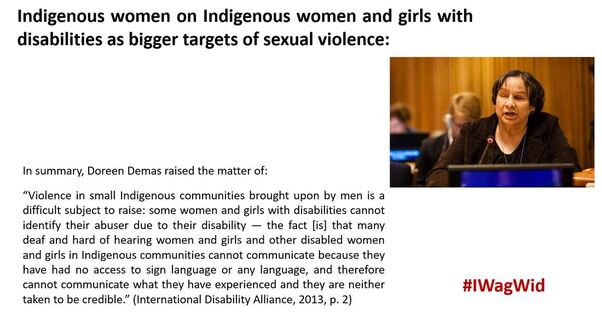 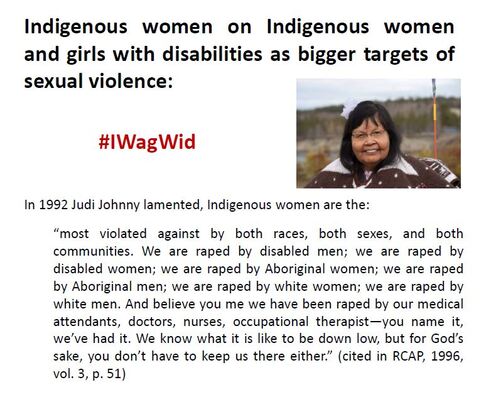  Lynn is an author, advocate, artist, and public speaker. Her work encompasses both anti-colonial work and the celebration of Indigenous knowledge. She challenges Canada’s practices, policies, and laws of colonial genocide such as the land claims and self-government process, sex-discrimination in the Indian Act, the continued destruction of Akikpautik / Chaudière Falls–an Anishinaabeg sacred place, and Canada’s lack of policy addressing Indigenous women and girls with disabilities who are bigger targets of sexual violence. © All Rights Reserved 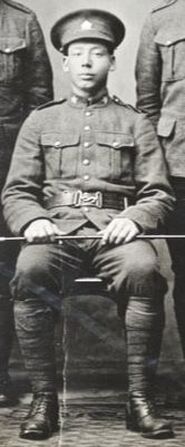 I never met my great grandfather, Joseph Gagnon, I only heard oral stories about him. One story I heard from my grandmother’s and father’s generations is that he is buried in St. Columba’s Cemetery in Pembroke Ontario. I was told, though, that the exact location of his final resting place is unknown because no grave marker stone was installed. Many winters and many more moons ago I took the trek from Toronto to see for myself and sure enough there was no grave marker stone to be found and as a result I was unsure where to place my semma (Tobacco). While I have been on a long journey of coming to know who I am as an Algonquin Anishinaabe person, receiving oral stories, learning how to read and write, conducting archival research, and a ridiculously long court process, I vowed that one day I would dive deeper into this situation of addressing Joseph Gagnon’s final resting place and see if I could have a grave marker installed so the next seven generations would better be able remember him and his role as a proud WW1 Veteran. This is an iteration of my story in written form. Of course, it is more complex and nuanced than these words on a page. Before I begin, and as a re-cap, Joseph was born on April 7, 1888 in Calabogie Ontario to parents Joseph Gagnon and Angeline Gagnon (nee Jocko); he lived in the reserve community of Golden Lake First Nation, now Pikwakanagan First Nation; he was a Private in the 207th Battalion; he departed for England on May 28th, 1917; he was wounded in the field with gun shots to his left leg and right arm; he returned to Canada on December 30th, 1918; and he died on October 30th, 1939. It is important for me to note here that Joseph’s attestation papers list his birth year as 1890; yet his certificates of birth and baptism record his birth year as 1888, and further his marriage record implies his birth year is 1888 as well. I am opting to go with the year 1888. It is also important that I state here that in the records, sometimes his last name is spelled Gagne. Family members and people who want to read more about Joseph can visit: https://www.canadashistory.ca/explore/first-nations-inuit-metis/fighting-for-recognition They can also find his attestation papers at: https://central.bac-lac.gc.ca/.item/?op=pdf&app=CEF&id=B3358-S084&fbclid=IwAR1fJmZqbZ_C2dfNb5ugGQgYErMaB96CMR9TMW0LV7fF8GT9VWniH5m5V3s In moving along, in the last several months, possibly motivated by several family deaths and my older age, I decided I had to finally take on this matter and have a grave marker stone created for my great grandfather. Bryce Gagnon, who is my father’s generation, a cousin, encouraged me to take it on. My preference was that he take it on, but for whatever reason he opted to pass that responsibility on to me, motivating me along. With that explained I will break down my process in numbered steps as a measure to provide clarity for other people to best follow - after all, they may be in the same situation as I am in. I work hard serving. First, as a new learner of the World Wars and what it means to be a veteran of Canada I opted to reach out to Veterans Affairs Canada via email asking if they could help me. Three weeks later I received an email from the Grave Marker Maintenance Program telling me they had no information on where Joseph was interred. They directed me to the Last Post Fund (LPF) that has an Unmarked Grave Program, providing grave markers for Indigenous veterans that have been unmarked for over 5 years. And so I contacted them. The LPF told me I would have to determine the grave location, adding that if this was not possible there was another option. Essentially, a grave marker could be made that qualified “Buried elsewhere in the cemetery …” and it could be installed in a designated place where the cemetery administrators felt was appropriate. They also mentioned that as part of the Unmarked Grave Program, when the veteran was Indigenous, their Indigenous name and a traditional symbol could be added to the marker. 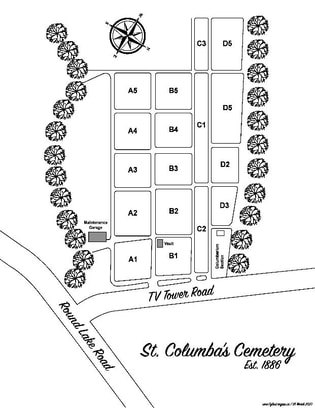 Second, like a good soldier following orders, I filled out the application LPF sent me. It was tedious. In order to have a grave marker installed, they required: Joseph’s date of death; a confirmation from the cemetery of his burial (even though his exact location is unknown); approval from the cemetery administrator to install the grave marker and also provide the location where the grave marker would be installed. Those wishing to learn more about the Last Post Fund can visit: https://www.lastpostfund.ca/ Third, I contacted St. Columba’s Cemetery asking if they held a record of his burial, and if so the exact location of his final resting place. I told the cemetery administrator about my plan to have a grave marker installed for Joseph through LPF. Like the administrator at LPF, the cemetery administrator was wonderful in helping me move through my frustrations. I am tired; all the time I am tired. There seems to be no end to what has happened to the Algonquin Anishinaabeg. Unfortunately, the cemetery administrator told me that the burial records were burned in a fire and thus they could not provide his exact resting place. Your heart sinks at moments like these. Regardless of not knowing the exact location, the administrator did assure me they were committed to helping me in my effort where within a few weeks they managed to find a record that confirmed Joseph was indeed buried in St. Columba’s Cemetery. The administrator sent me a clip of the record. Although there are a few discrepancies, such as his age and his wife’s full name, Annie Meness versus Annie Monett. Further, they confirmed he was possibly in area A2 where lots 654 are located, or possibly in area B1 where lots 216 are located (see above and below). It was explained that these lots have 8 and 4 grave plots respectively. Learning, or rather re-learning this, was unfortunate but this is the nature of fire. As a sacred element along with water, wind, and rock it rules over human made laws and policies. Most Anishinaabeg know this. 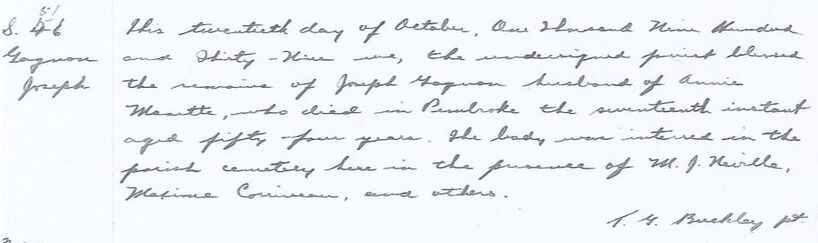 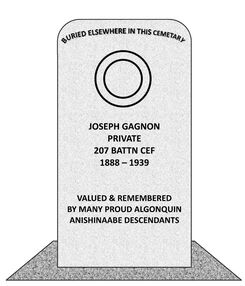 The cemetery administrator gained permission to have a grave marker installed and they confirmed an installation location. The location is in A1, just off of TV Tower Road (again see above). With all of this knowledge gathered I then filled out the LPF application. It was here at this moment of my process that I was able to draw on my creative skills and the depth of Indigenous knowledge I had worked hard to acquire, adding an important Anishinaabe symbol and a meaningful epitaph to my rendering of the grave marker stone. LPF accepted my rendering, ensuring it fit within their requirements, and they forwarded it on to the carver who will create a final version of the grave marker before it is carved into granite. I am told this will be sent to me for a final “ok”. Fourth, and lastly, it is my hope to have Joseph Gagnon’s grave marker stone installed on November 11, 2024 (this date is subject to change) with many of his grandchildren, great grandchildren, and great great grandchildren in attendance. They are the descendants of Kenneth Gagnon, Viola Gagnon (my grandmother), Gordon Gagnon, Celia Gagnon, and Steve Gagnon (See photo, 1965, left to right). My goal and hope of this exercise of mine, and the eventual installation of a grave marker, is that all of his Algonquin Anishinaabe descendants will remember their ancestor Joseph Gagnon. 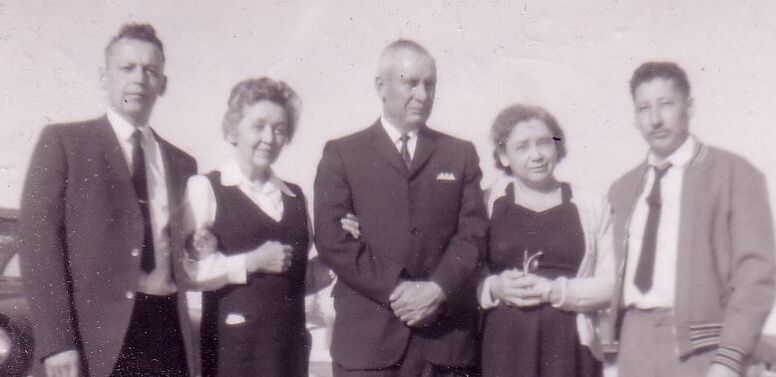  Lynn is an author, advocate, artist, and public speaker. Her work encompasses both anti-colonial work and the celebration of Indigenous knowledge. She challenges Canada’s practices, policies, and laws of colonial genocide such as the land claims and self-government process, sex-discrimination in the Indian Act, the continued destruction of Akikpautik / Chaudière Falls–an Anishinaabeg sacred place, and Canada’s lack of policy addressing Indigenous women and girls with disabilities who are bigger targets of sexual violence. © All Rights Reserved 6/24/2023 0 Comments The Pretendian Dilemma"Well-known Aboriginal families in the Sharbot Lake area such as the Badour, Cota, and Hollywood families are no longer included in the Algonquin Land Claim." 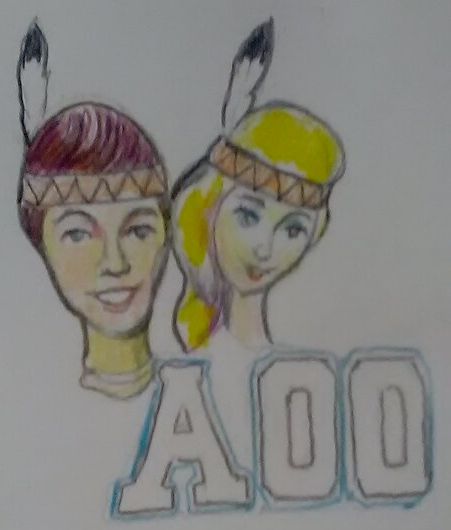 "A pretendian's paradise" By John Tenasco, 2023. Pencil crayon "A pretendian's paradise" By John Tenasco, 2023. Pencil crayon "Why are there so many pretendians?" Red River Metis attorney Jean Teillet, suggests that as many as 25% of academics who claim to be Indigenous are guilty of "identity fraud"; and there are as many as a quarter of a million throughout Canada. Some of the guilty people are now famous icons. The University of Saskatchewan commissioned Teillet to research the topic: click here Betty Nippi-Albright explains, identity frauds are employed in universities and with the various governments of Canada. She continues they are causing great harm to Indigenous people when they take up spaces intended for them. Further, pretendian frauds should be criminally charged, after all, "fraud is fraud". The Algonquins of Ontario, the structure through which Canada's ongoing Algonquin genocide continues, has a huge pretendian infestation; some people have said as many as 4,000. In 2013, 700 people from the Sharbot Lake / Ardoch area were removed. In 2019 it was said that as many as 2,500 pretendian Algonquin have been removed from enrollment. A 2022 award winning CBC documentary aptly called, The Pretendians, outed the so-called Ardoch First Nation and Allies for harbouring pretendians within a fictitious Cybernet community. It is hoped that the 2023 Algonquin tribunal hearing process removes as many as 2,000 additional pretendians. A lot of people ask me, "why are there so many pretendians?" My usual response is, "I don't know, ask White women as they are the most guilty." Regardless, there is a lot of discussion about the phenomena and below are some of the reasons I have heard . . . 1 The are psychologically ill 2 To gain access to hunting and fishing rights 3 To gain access to scholarships, jobs, and research funding 4 To gain access to programs and services 5 To leverage race in patriarchal society 6 To gain access to ceremonial spaces 7 To infiltrate Indigenous movements and surveille Indigenous resistance 8 To raise their profile in the arts such as theater, music, and as a writer 9 They suffer from the White Saviourism complex 10 To protect their fee simple land from prospecting, drilling, and mining 11 To sabotage Indigenous people and their rights out of jealousy, resent, and hatred 12 To gain access the political spaces of chiefs and councilors 13 Their parents lied and now they believe they are Indigenous 14 They have conflated respect and allyship with theft and cultural appropriation 15 Nation statehood has erased who they are and they lack a meaningful culture/identity 16 They have Indigenous family members and do not understand the difference between lateral and direct relations 17 Universities need accommodating, obliging, needful administrative staff and professors and pretendians serve well as they have no basis of who they claim they are 18 In the Algonquin land claims process membership has become partisan where enrollment was manipulated to entrench particular Algonquin Negotiation Representatives at the Algonquins of Ontario negotiation table It is about time that White women hold White women accountable for what they are doing to Indigenous people.  Lynn is an author, advocate, artist, and public speaker. Her work encompasses both anti-colonial work and the celebration of Indigenous knowledge. She challenges Canada’s practices, policies, and laws of colonial genocide such as the land claims and self-government process, sex-discrimination in the Indian Act, the continued destruction of Akikpautik / Chaudière Falls–an Anishinaabeg sacred place, and Canada’s lack of policy addressing Indigenous women and girls with disabilities who are bigger targets of sexual violence.
© All Rights Reserved 5/29/2023 0 Comments Lynn Gehl: Sex Discrimination, Algonquin Genocide, and Indigenous Women & Girls with DisabilitiesThis video is an edited selection of questions and my responses from the March 30, 2023 famous5 speaking event regarding the 2022 Governor General's Awards in Commemoration of the Persons Case. Six Persons Case awards are granted annually. I was honoured to be nominated for the work I did challenging the sex discrimination in the Indian Act re unknown and unstated paternity, and the "6(1)a All the Way!" effort with Sharon McIvor and other members of the Indigenous Famous Six. While I undertook this effort I also worked hard on two additional matters: the Algonquin land claims process aka the Algonquin genocide; and Indigenous women and girls with disabilities who are bigger targets of sexual, domestic, and online abuse. Given the intersectional nature and the incredible oppression that Indigenous people have to contend with, and given that the award ceremony took place on traditional Algonquin territory, I opted to serve again by narrowing the longer panel discussion to matters that represent what I have worked on for more than 3 decades.  Lynn is an author, advocate, artist, and public speaker. Her work encompasses both anti-colonial work and the celebration of Indigenous knowledge. She challenges Canada’s practices, policies, and laws of colonial genocide such as the land claims and self-government process, sex-discrimination in the Indian Act, the continued destruction of Akikpautik / Chaudière Falls–an Anishinaabeg sacred place, and Canada’s lack of policy addressing Indigenous women and girls with disabilities who are bigger targets of sexual violence. She weaves wampum belts, builds petro-forms, and paints. She also has several professionally published peer reviewed books: “Gehl v Canada: Challenging Sex Discrimination in the Indian Act” (2021), “Claiming Anishinaabe: Decolonizing the Human Spirit” (2017), “The Truth that Wampum Tells: My Debwewin on the Algonquin Land Claims Process” (2014), and “Anishinaabeg Stories: Featuring Petroglyphs, Petrographs, and Wampum Belts” (2012). She has several academic contributions in journals and chapters in books; more than one-hundred community contributions in magazines, websites, news papers, and op-eds; as well as two-hundred personal blogs. Lynn is frequently called upon as an expert by various media outlets to offer commentary on Indigenous issues. © All Rights Reserved
Genuine settler allies are well versed in knowing about their need to serve the most oppressed in the community versus take on a lead role in community action. Genuine allies know that they must literally stand behind the critical thinkers and intellectuals in Indigenous communities versus tokenize someone for their own selfish validation in their project that they themselves have chosen. Many settlers do not really think about the amount of money and resources that Canada invests in their ‘strategies of nationalism’ in shaping its citizenry. Millions and Millions and Millions annually! Through this bottomless pit of money, Canada has created a national flag with many re-inventions for their special events, and has created a national song and continually pumps it through primary and secondary schools. As a matter-of-fact Canada spent $500 million on Canada Day 150 for the sole purpose of state nationalism. These national strategies powerfully shape Canadians into thinking they are Canadians. Sadly, as a result in their hearts and dreams, they are Canadians; They don’t know anything better. What is more, many people do not think about how it is that Canada continually and continually and continually harnesses Indigenous people and their regalia in their national celebrations and ‘reconciliation moments’ for the sole purpose of optics of doing the right thing. Good Canadians continually gobble this up over and over and over again – with little to no critical thinking. But it gets worse. Some settlers continue to think it is their role to pave the road of Indigenous salvation. Yet, most settlers have no clue about the foundations of Indigenous knowledge, no clue that they need to decolonize or how to decolonize, that they need to think through critical theory or for that matter that critical theory exists, and as such most settlers continue to lack the knowledge of how best to serve Indigenous people. Clearly, it stands to reason that settler people should not interfere with Indigenous politics and politicians. This is because they lack the knowledge of who is doing the right thing in the Indigenous community and who is harming the people in the Indigenous community. This is precisely why settlers are better off standing behind and serving the most oppressed such as the homeless, the poor, the people with disabilities, and people struggling with addiction. When settlers serve the most oppressed in concrete and practical ways there is little to no chance of them causing further harm to other members in the community. Settlers interested in peace and systems of power and how it corrupts governance structures, such as how capitalism, racism, sexism, and ableism are horrible oppressors causing great harm, must look critically at the horrid power inherent in Canada’s ‘strategies of nationalism’ and how all too often settlers become and are complicit in this very power. Genuine settler allies do not interfere with Indigenous politics and politicians. Genuine allies have decolonized, know a legitimate Indigenous paradigm exists, respects the Two Row Wampum Belt, and they work to serve the most oppressed. When they are not serving the most oppressed, they end up serving the very power structure that is harming Indigenous people. Many Indigenous people are hungry, and they rely on food banks. Why not serve a food bank instead of getting involved with Indigenous politics and politicians? For Pete’s sake, it is not Rock science. Activate the most precious gift the Creator bestowed you with: your mind. Indigenous events must emerge in situ and organically from Indigenous people, where everyone should always deeply think critically about if the event is a genuine Indigenous event or is it just another political event driven by Canadian politics and thus propaganda and more of the same old same old. When a settler man chooses an Indigenous topic or event such as Chief Penesi Day and steers it forward, they are taking a lead when they should not. It is not their role, and it is not their role to get tied up with Indigenous politicians. Everyone should boycott Chief Penesi Day! Otherwise, it is destined to become the very platform that Canada relies on in its “celebration” of the Ontario Algonquin land claims, a so-called modern treaty that will embody the continuation of the Algonquin genocide. This is the power of ‘strategies of nationalism’. It perpetuates nation state propaganda. https://www.lynngehl.com/gehl-blogging/a-colonized-ally-meets-a-decolonized-ally-this-is-what-they-learn https://www.lynngehl.com/ally-bill-of-responsibilities.html https://www.thefeministwire.com/2013/04/clearing-the-path-for-the-turtle/  Lynn is an author, advocate, artist, and public speaker. Her work encompasses both anti-colonial work and the celebration of Indigenous knowledge. She challenges Canada’s practices, policies, and laws of colonial genocide such as the land claims and self-government process, sex-discrimination in the Indian Act, the continued destruction of Akikpautik / Chaudière Falls–an Anishinaabeg sacred place, and Canada’s lack of policy addressing Indigenous women and girls with disabilities who are bigger targets of sexual violence. She weaves wampum belts, builds petro-forms, and paints. She also has several professionally published peer reviewed books: “Gehl v Canada: Challenging Sex Discrimination in the Indian Act” (2021), “Claiming Anishinaabe: Decolonizing the Human Spirit” (2017), “The Truth that Wampum Tells: My Debwewin on the Algonquin Land Claims Process” (2014), and “Anishinaabeg Stories: Featuring Petroglyphs, Petrographs, and Wampum Belts” (2012). She has several academic contributions in journals and chapters in books; more than one-hundred community contributions in magazines, websites, news papers, and op-eds; as well as two-hundred personal blogs. Lynn is frequently called upon as an expert by various media outlets to offer commentary on Indigenous issues.
 I am struck by the very practise of Pikwakanagan First Nation surveys asking questions about the place of Algonquin Indigenous knowledge (AIK), how to prioritize AIK, and when and how to apply AIK? This is so great! What strikes me about this process is that Pikwakanagan First Nation has yet to establish a clear understanding and model or models of where AIK is located and how we create more of it as we move into the future. It is crucial that various models of AIK be established as it will set the foundation of the discussion. Pikwakanagan can ask its intellectuals to develop various definitions and models of AIK using our beliefs and assumptions to shape them. With these models in hand community people will more easily think about AIK, have collective discussions about AIK, and move forward with AIK in a good way. The strength of models, shaped by our Algonquin beliefs, is that they serve to guide our thinking and movement forward. This is the strength of beliefs and models. To be clear, models are not Truth, rather they are models that shape truth, and they are crucial in terms of keeping us on track. What is more, there can be more than one model for this same topic because they are frameworks of thought versus being intended to be an absolute Truth. Some people reading this may gripe, arguing that models are colonial. This is not so. Women always held a cognitive model and/or patterns when they were making moccasins, and men also rely on cognitive models of their trapline and hunting territories using natural land features to help them. Further, the Sun and Moon rising in the East and setting in the West is a belief and model of reality that establishes a solid foundation of who we are. Algonquin also relied on maps that they could draw in the sand or the mind’s eyes of other people. That said, of course Algonquin had models, to deny this is to say we were so primitive and not intelligent enough to have had governance and thinking structures in our worlds. We did, and we still do. Our Algonquin ancestors were intelligent and we are intelligent. Another model of the Algonquin Anishinaabe worldview is the belief and ideology of the Four Sacred Elements and the Four Layers of Creation. As most know, there are Four Sacred Elements: Rock, Water, Wind, and Fire. And there are Four Orders of Creation: the Four Sacred Elements, the Tree Nations, the Animal Nations, and the Human Nations. As an Algonquin Indigenous scholar with my doctorate in Indigenous Studies, versus for example a doctorate in history or cultural studies, I am trained in Indigenous knowledge philosophy whereas such the understandings, models and theories relied on are always Algonquin. Given this, I am always thinking through AIK and doing my best to let it frame what I know, how I think, and what I do. While I of course value that AIK is shaped by ancient knowledge, language, and the land, and I do rely on them to guide me, one crucial model I rely on is the combination of the Four Sacred Elements and the Four Orders of Creation. For example, several years ago when I was learning and thinking about the dangers of nuclear energy I of course relied on my training in the sciences and my experiences measuring toxic organic pollution to guide my learning about the dangerous effects of radioactive particles. Through this I learned that radioactive particles are carcinogenic, teratogenic, and mutagenic. In these ways, radiation is dangerous to humans and our babies. But my thinking was also relied on the cognitive model of the Four Sacred Elements and the Four Orders of Creation. Thinking through the need to respect the Four Sacred Elements I was able to understand that in cracking atoms, the nuclear industry destroys Rock; I was able to understand that the process of cooling nuclear reactors depends on the cold Water found in the deep rivers, such as the Ottawa River, thus warming them; I was able to understand that the Wind and air we all breathe is contaminated through the process of vented emissions; and I also realized that Fire is generated unnecessarily for destructive and dangerous means. What is more, my thinking also relied on the cognitive model of the need to respect the Four Orders of Creation. Through this I was able to understand that not only is nuclear energy destroying the Four Sacred Elements and Human Nations, it is also harming the Tree Nations and the Animal Nations. When human beings rely on the economic model to guide us, versus walking the knowing process back to, and through, the Four Sacred Element and the Four Orders of Creation, we fail to be the human beings Creator wants us to be. And we fail to operate within the Algonquin Indigenous Knowledge worldview. Read my biographical note: www.lynngehl.com/biographical-note.html
Contact me, subscribe to my blog, and/or my newsletter: www.lynngehl.com/contact.html 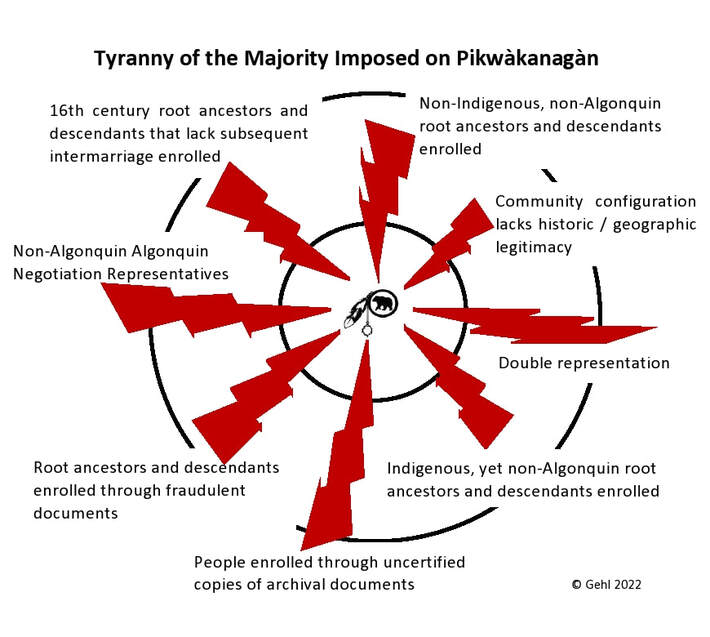  Within the Algonquins of Ontario (AOO) land claims process, several issues are confounding who is Algonquin and who is not Algonquin. It is important for people to reflect on these issues deeply because the people identified will be eligible to vote on the final settlement package that will extinguish, relinquish, define our rights completely, modify, and/or terminate Algonquin land and resource rights. And it will also divide the broader Algonquin Nation that includes the Algonquin living in what is called Quebec. Of course the Algonquin do not need non-Algonquin voting on Algonquin matters. While not comprehensive, I offer here a discussion of many of the issues. First, the Algonquins of Pikwàkanagàn First Nation leadership must address the tyranny of the majority of the non-status. A huge issue that Pikwàkanagàn First Nation leadership has to contend with is the larger body of non-status Algonquin enrolled through the AOO land claim process. A ratification process that protects Pikwàkanagàn members from the tyranny of this constructed majority, or alternatively said the desires of the majority, has to be deeply considered and practically addressed. Yes, Pikwàkanagàn First Nation members are equal to the other so-called community members, but it is also different in that the people in the other so-called communities are loosely dispersed within various municipalities, townships, cities, and villages. This is not to say that Pikwàkanagàn First Nation is special. Rather, it is to say Pikwàkanagàn First Nation is equal, yet differently equal to the other communities. Second, Pikwàkanagàn First Nation leadership must insist on a strong evidentiary requirement process that insists on ‘certified original copies’ of all archival documents. In the past there was an issue with defining and determining the evidentiary requirements when enrolling people who are potentially Algonquin in the land claims process. When enrolling non-status Algonquin, Pikwàkanagàn First Nation leadership must insist on certified original copies of all archival documents – birth, marriage, death, census, baptismal, and letters – regarding Algonquin enrolment and beneficiary status. Sworn affidavits must also be required when the documents cannot be certified as original. This is especially important at the protest stage. People should not be allowed to drop evidence at this stage unless it has undergone a provenance testing process. Contrary to what has been reported on, the process of determining voters has been far from, “very rigorous” (Potts in Vetter, 2017). Third, Pikwàkanagàn First Nation leadership must remove all the non-Indigenous / non-Algonquin root ancestors. It is said that there are two or more French Canadian women on the root ancestor list who are not Algonquin or Indigenous (see Coburn, 2022a and 2022b; Di Gangi and McBride, 2016; Leo 2021a and 2021b; Leroux, 2021 and 2022). They and all their descendants must be removed. Four, Pikwàkanagàn First Nation leadership must remove all the Indigenous yet non-Algonquin root ancestors. It is said that there are a least six Indigenous women who are not Algonquin on the root ancestor list (see Coburn, 2022a and 2022b; Di Gangi and McBride, 2016; Leo, 2021a and 2021b; Leroux, 2021 and 2022). They, and all their descendants, must be removed. Five, Pikwàkanagàn First Nation leadership must remove people enrolled through 16th century Algonquin ancestors where there has been no further intermarriage and cultural exchange (see Di Gangi and McBride, 2016; Leroux, 2021 and 2022). Clearly people assimilated into the Canadian mosaic; people who lack additional intermarriage and a cultural connection; and people who do not demonstrate an Algonquin identity where reciprocity – versus economic or employment as their only agenda – is not part of their personal agency, must be removed. Six, Pikwàkanagàn First Nation leadership must remove all people enrolled through fraudulent documents and letters (see Coburn, 2022a and 2022b; Leo, 2021a and 2021b; Leroux, 2021 and 2022). Again, there is an issue with defining and determining the evidentiary requirements when enrolling people who are potentially Algonquin in the land claim process. The process must insist on ‘certified original copies’ of all archival documents or sworn affidavits. Seven, Pikwàkanagàn First Nation leadership must address the lack of historic and geographic configuration at the AOO table. Once the issues resulting in the large number of non-Algonquin enrollees are addressed it will become more apparent that the current configuration at the AOO table lacks legitimacy. Said another way, the AOO voting configuration must represent Algonquin historic configuration versus false divisions that have led to more AOO Algonquin Negotiation Representatives (ANRs) over Pikwàkanàgan First Nation ANRs. It must be deeply appreciated that the reason the ANRs do not want to address the issue of people appropriating Algonquin identity, also called “the pretendian issue”, is because once it is addressed it will become crystal clear that several of the communities and thus ANRs are not required. Pikwàkanagàn First Nation Chief and Council are stuck in a circular argument with the very people who benefit from the corruption and appropriation of Algonquin identity, yet there has been four layers of analysis on this very matter (see Coburn, 2022a and 2022b; Di Gangi and McBride, 2016; Leo, 2021a and 2021b; Leroux, 2021 and 2022). The AOO table must be rooted in ‘reason of mind’ versus merely what the heart feels, where the ANR community configuration holds historic and geographic legitimacy (Coburn, 2021). Eight, Pikwàkanagàn First Nation leadership must address the Algonquin descendants of women who are now entitled through the Indian Act amendments of Bill S-3, Bill C-3, and Bill C-31. Many people are aware that due to sex discrimination in the Indian Act many women and their descendants were removed from the community of Pikwàkanagàn (Gehl, 2021). Greater, efforts must be made to have these people registered as per the Indian Act and then encouraged to apply for membership in their mother’s, grandmother’s, great-grandmother’s community. To do otherwise is to entrench the sex discrimination in the Indian Act in the final agreement. Nine, considering the amendments in the Indian Act, Pikwàkanagàn First Nation must address all situations of double or dual representation. Enrolled Algonquin community members and for that matter ANRs must be enrolled in only one community, not two. It is not good governance or good government on the part of Pikwàkanagàn First Nation for people to be a member of one of the communities as well as a member of Pikwàkanagàn First Nation. The resolution of this matter should encourage the good governance of personal agency within, where if this fails Pikwàkanagàn First Nation leadership must exercise its jurisdiction according to good reasoning and good government practices. Note: This list is hardly exhaustive. References Coburn, V. (2021, November). Historic Communities Research. Presented During Pikwakanagan First Nation Treaty Pause Meeting. Coburn, V. (2022a). Genealogy of Thomas St-Jean dit Lagarde (1801-1853ca). Coburn, V. (2022b). Genealogy of Sophie Emelie Jamme dite Carriere (1807-1886). Di Gangi, P., & McBride, A. (2016). Review of AOO Voter’s List of December 2, 2015. Algonquin Nation Secretariat Analysis of AOO Voter’s List. Gehl, L. (2021). Gehl v Canada: Challenging Sex Discrimination in the Indian Act. Regina: U of Regina Press. Leo, G. (2021a, August 9). Mysterious letter linking 1,000 people to $1B Algonquin treaty likely fake, CBC investigation finds. CBC News. Retrieved from https://www.cbc.ca/news/canada/saskatchewan/letter-lagarde-algonquin-1.6121432? Leo, G. (2021b, September 13). Push to remove ‘pretendians’ from Algonquin membership rekindled after CBC investigation. CBC News. Retrieved from https://www.cbc.ca/news/canada/saskatchewan/algonquin-ancestry-lagarde-letter-follow-1.6171830 Leroux, D. (2021, Sept.). Beneficiary Criteria / Root Ancestor Research. First Nation Treaty Pause Meeting. Leroux, D. (2022). The RHW Treaty Governance Forum [Video]. Youtube. Retrieved from https://www.youtube.com/watch?v=9LiXdg3dW24&ab_channel=RobinsonHuronWaawiindamaagewin Vetter, C. (2017, May 17). Treaties and Land Claims. Ottawa Life Magazine. Read my biographical note: www.lynngehl.com/biographical-note.html
Contact me, subscribe to my blog, and/or my newsletter: www.lynngehl.com/contact.html 9/12/2022 0 Comments Cultural Appropriation DetectorKnow your rights! Since the arrival of the new comers to Turtle Island, explorers, cartographers, botanists, lumber men, trappers, linguists, anthropologists, and sociologists have appropriated Indigenous knowledge for their own interests without regard for the wellness of Indigenous people or the Land. Unfortunately, the appropriation of Indigenous knowledge continues to this day. Prime ministers, corporations, journalists, academics, and many Canadians continue to think the Indigenous mind and our knowledge systems are an entity they can mine, take from, and modify to their liking without requesting permission, or offering respect and remuneration to Indigenous Nations and people. In this way colonization continues. That said, there is a relationship between intellectual property, copyright, fair dealing, plagiarism, and cultural appropriation. Here are some detection tools that will prove useful in identifying it. First though, a disclaimer: I am not a lawyer. It is important that you do your own research, your own critical thinking, and hire a lawyer if required. . . . 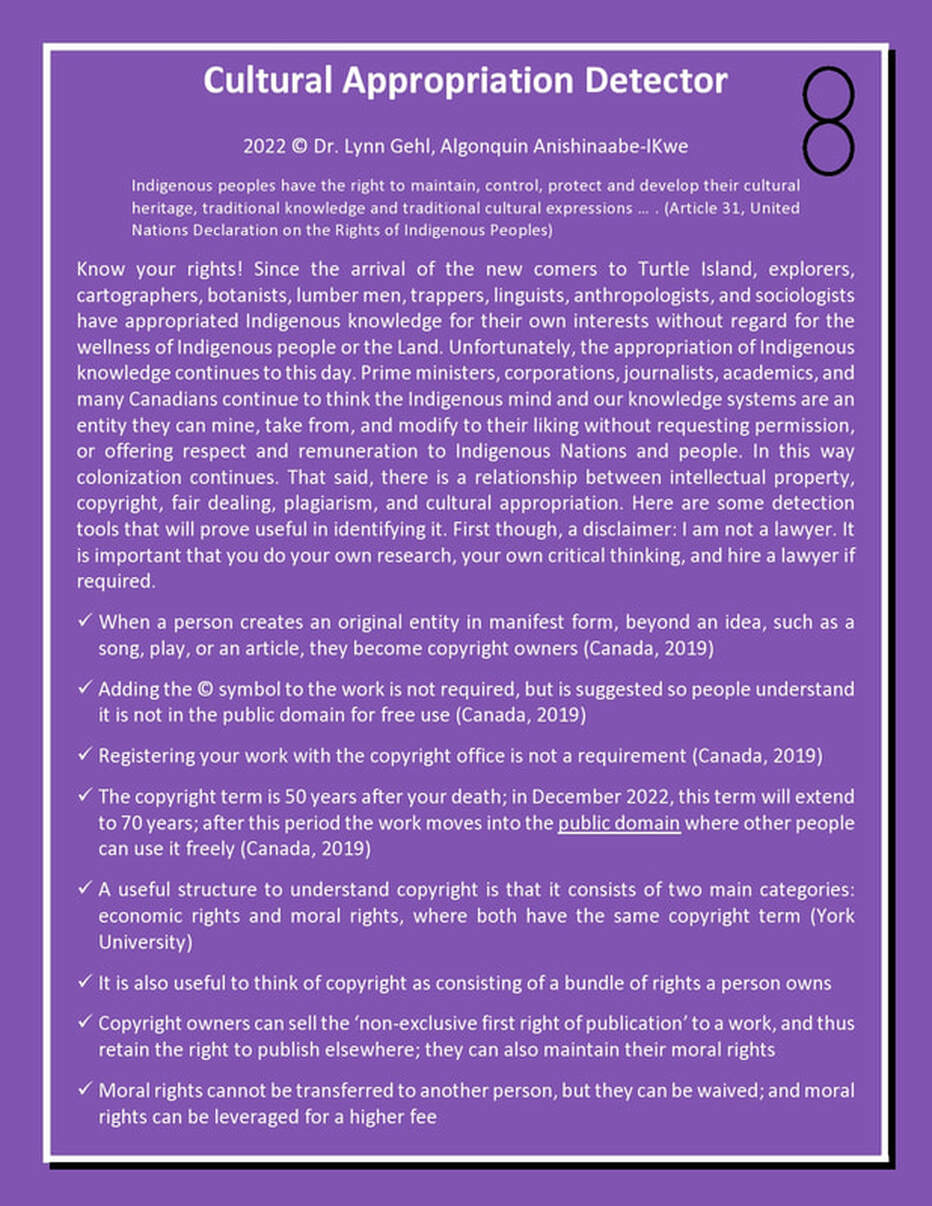 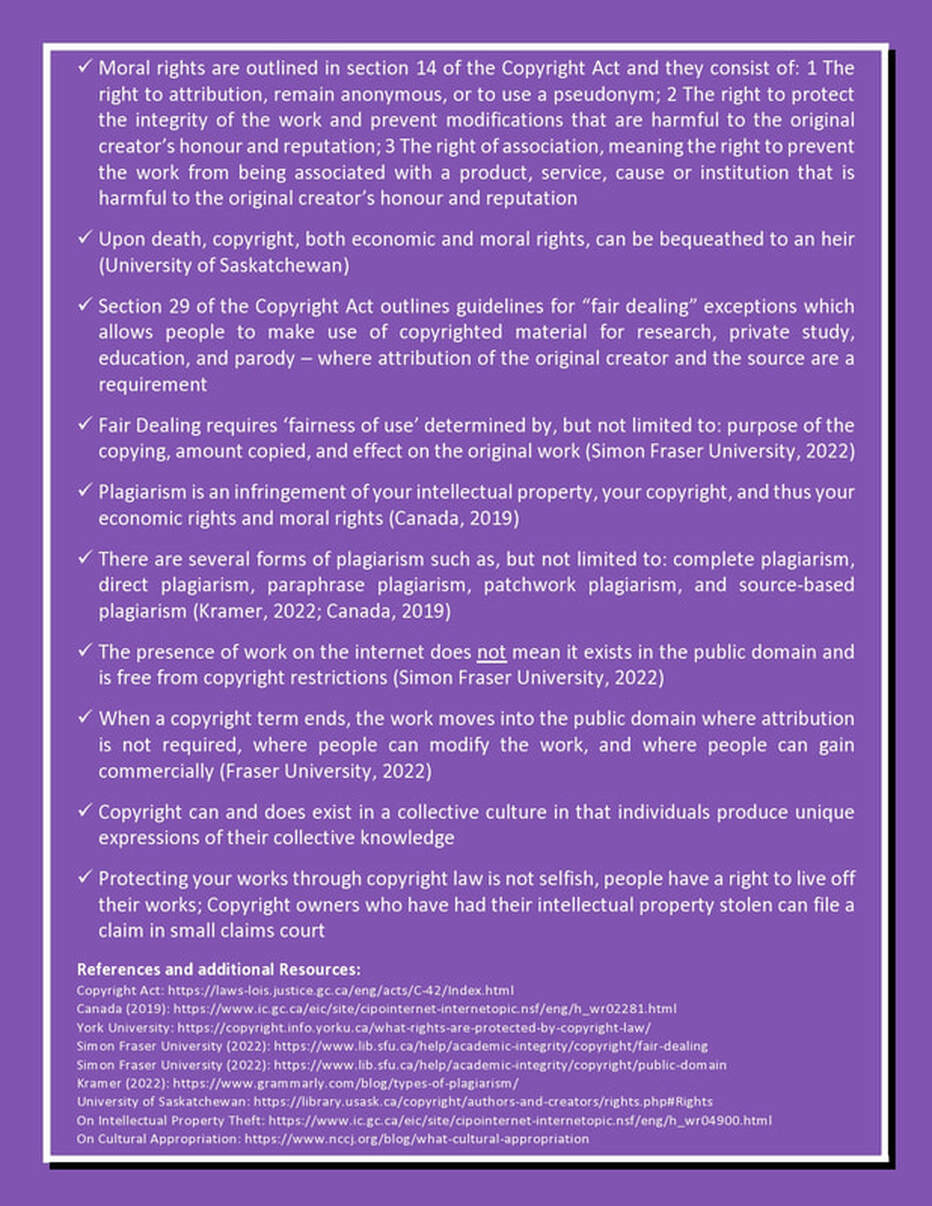 Read my biographical note: www.lynngehl.com/biographical-note.html
Contact me, subscribe to my blog, and/or my newsletter: www.lynngehl.com/contact.html
This interview with Anna Maria Tremonti on CBC the Current was such a good experience for me. We discussed many things such as my book Claiming Anishinaabe, Indigenous knowledge, the intelligence of the heart, Algonquin politics, and Canada's ongoing genocide. This episode of The Current was titled "How author Lynn Gehl reclaimed her Indigenous roots" and it original aired on Nov 9th, 2017. Listen to the podcast here: Read my biographical note: www.lynngehl.com/biographical-note.html Contact me, subscribe to my blog, and/or my newsletter: www.lynngehl.com/contact.html 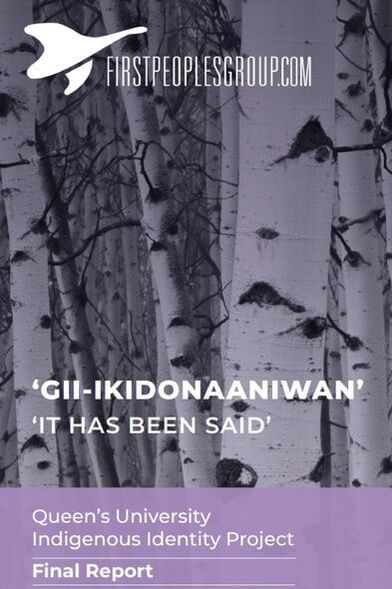 "Chief Haymond of Kebaowek First Nation echoed the idea that many of the people who voted in the main referendum did not meet reasonable eligibility requirements". "... such as the Badour, Cota, and Hollywood families are no longer included in the Algonquin Land Claim". Kwey Kwey, I am a member of Pikwakanagan First Nation. The Algonquin history is a terrible history. While it is more complex, for the most part the French of New France allocated reserves for Algonquin without treaty. When the French lost to the British, they realized they needed to respect the French as allies in part because they had populated the land and thus held power. Then moving around the top of the Great Lakes and out across the plains all the way to the mountains the British treatied with Indigenous Nations creating reserves as they colonized the land and waterscapes. As the British did this they refused to treaty with the Algonquin Nation. Today there are Algonquin reserves in both Quebec and in Ontario: nine and one respectively. Yet, in both Quebec and Ontario not all Algonquin live on reserve land as some communities were denied. As a result not all Algonquin are affiliated with a recognized First Nation where consequently many are not registered as status Indians as defined by the Indian Act. Finally, after more than 250 years since the 1764 Treaty at Niagara, it was in the early 1990s when Canada and Ontario agreed to enter into a land claim process with Pikwakanagan taking the "lead". This process of accepting the land claim limited to the Ontario side of the river is laden with many legitimate critiques. Many Algonquin people, and rightly so, are not happy with the division of our great territory. As Algonquin Anishinaabe and leading thinker Dr. Veldon Coburn has pointed out, our territory should be a province in its own right where we manage our own land and resources. Sadly today Canada continues to hold the power, in the form of our resources, and continues to deny who the Algonquin are as a larger collective that spans across our mighty river. In taking this approach Canada is continuing to impose the colonial genocide the Doctrine of Discovery has unleashed. It is my thought that Canada is particularly motivated to harm the Algonquin, and horribly so, because its parliament buildings illegally squat on Algonquin territory. Eventually Pikwakanagan was placed in a situation of having to identify the non-status Algonquin as the Indian Act embodies sex discrimination; and also identify the Algonquin who were never affiliated with a federally recognized First Nation. This process of identifying has been very hard, but it is important that this be completed in a good and reasoned way because non-Algonquin people should not be voting on a final Algonquin land claim, especially a land claim that offers us so little, and that is, as Russell Diabo correctly argues, is primarily rooted in our termination as Indigenous Nations. Most people know I am well versed in issues of Indigenous identity politics and wellness. I completed my masters on the topic, and then there is the 30 year plus effort I took to protect Indigenous women and their children from the sex discrimination in the Indian Act (Gehl, 2017). Less people, though, are aware that I completed my doctoral work on the Algonquin land claim process as it was unfolding in Ontario. As such I know these land claim processes are rooted in colonial genocide (Gehl, 2014). During my learning I was intrigued by the counter hegemonic position that Bob Lovelace offered who lived in the Ardoch area and who helped structure what became then the “Ardoch Algonquin First Nation and Allies”. I had questions, though, in terms of who the Ardoch members were. Eventually I learned that Harold Perry and his relatives are Algonquin, but the larger presence of non-Algonquin was always puzzling to me. Although offered, I never became a member of Ardoch because it was not my community. I was from Pikwakanagan, even if they denied me because of the very bloody Indian Act. Today, as the Algonquins in Ontario (AOO) move closer toward voting on a final land claim things are heating up; well more like boiling over. Thanks to a CBC investigation by Geof Leo and the experts he relied on, and reports put forward by other valued researchers, we have discovered that there could be as many as 4,000 people enrolled in the AOO process who should not be. Many are enrolled through fraudulent documents, and many are enrolled through a 16th or 17th century ancestor without subsequent community interaction, cultural continuity, and community responsibility. Some of these people enrolled are scholars seeking well paid employment positions. This is important to value because employed scholars shape knowledge production through such things like admitting students into their programs, shaping curriculum and thus shaping minds, passing students through their comprehensive exams and the ethic review process, and through writing letters for scholarships and employment. The point is that we have many people claiming to be Algonquin who are not, both in terms of Ardoch and in terms of the Algonquins of Ontario land claim. When Ardoch members argue that they are being challenged because they are against the land claim, this is not correct, and is in fact a misleading obfuscation. The issue is the need for the Algonquin to clearly determine who is and who is not legitimate regardless if you are pro land claim or anti land claim. I have read the First Peoples Group’s July 7, 2022 report titled “Gii-Ikidonaaniwan–It Has Been Said”, about how it is that Queen’s University has become complicit in wrongly representing who is and who is not Algonquin. In reading this report, of course I understand that knowledge is shaped by both the methodology and methods employed, as well as shaped by the amount of money and time allocated to the research and final knowledge production. This is the case with all knowledge productions. Of course questions generate and shape knowledge. Regardless, after reading Gii-Ikidonaaniwan as an Algonquin intellectual I felt it represented a good qualitative analysis of what Queen’s University students would be concerned with. I also read the unauthored / unsigned Ardoch response dated August 3, 2022 to Gii-Ikidonaaniwan and feel that it is too defensive and nastily so. What struck me most is that whoever wrote the response projected too much off of the issue of who is and who is not a federal recognized First Nation, which Ardoch is not; as well as projected off the issue of Indian status registration. The Ardoch response then proceeds to rely too heavily on the Supreme Court of Canada in making the claim of who Ardoch is. I find this odd because both the Indian Act and the Supreme Court of Canada are colonial institutions. Clearly the agency of one or two individuals carrying a court case forward all the way to the Supreme Court of Canada does not legitimate the existence of an entire First Nation community. Further, for the most part court processes rest on the material presented in paper form versus what is really happening on the land. Most people understand the limitations of the methodology of legal positivism and the process of resting truth on evidence, evidence that is shaped and mediated by power. Truth is not found or identified through the legal system. I know this all too well through Gehl v Canada (2017). Interestingly, it was the current Chancellor of Queen’s University, the Honourable Murray Sinclair, who wrote the Gehl clauses now present in the Indian Act. It is my thought that a better Ardoch response to Gii-Ikidonaaniwan would be for the leadership to clearly stand up and identify who they are as Algonquin. It is my thought that a better Ardoch response to Gii-Ikidonaaniwan would be for the Ardoch leadership to clearly name who their Algonquin root ancestors are. It is my thought that a better Ardoch response to Gii-Ikidonaaniwan would be offering a clear explanation of how many of their members descend from these Algonquin root ancestors. It is my thought that a better Ardoch response to Gii-Ikidonaaniwan would be offering a clear explanation of how many of the Ardoch members are adopted. It is my thought that a better Ardoch response to Gii-Ikidonaaniwan would be to offer a discussion of who their membership clerk is with an explanation of their qualifications as an archivist and genealogist. It is my thought that a better Ardoch response to Gii-Ikidonaaniwan would be a clear explanation of its membership criteria. It is my thought that a better Ardoch response to Gii-Ikidonaaniwan would be offering a clear list of the Ardoch membership. In short, I don’t think a harsh critique of Gii-Ikidonaaniwan was the best way to go. The larger Algonquin Nation, Queen’s University and their students are deserving of better truth. Nor do I think obfuscating through Supreme Court decisions is the way to go. Both the Supreme Court of Canada and the Indian Act are rooted on colonial oppression and the methodology of legal positivism. Finally, non-Indigenous people, or people who have picked up an ancient Indigenous ancestor to claim they are Algonquin, must respect that it has to be genuine Algonquin people who take up positions in universities because it is them who understand what we need. They need to move aside in a humble way. When people appropriate Algonquin identity, they are more likely to be subservient and compliant to someone else’s agenda. The Algonquin Nation needs genuine Algonquin who are well rooted in who they are as Algonquin because it is them who best understand the issues, and who best understand the importance of relying on Anishinaabe methodologies and methods, that in turn shape Algonquin knowledge productions, and thus subsequently serve to change policy and legislation in the direction needed for the Algonquin. Debwewin, Lynn Gehl, Algonquin Anishinaabe-IKwe See also: Di Gangi, P., & McBride, A. (2016). Review of AOO Voter’s List of December 2, 2015. Algonquin Nation Secretariat Analysis of AOO Voter’s List. https://www.scribd.com/doc/300528995/Algonquin-Nation-Secretariat-Analysis-of-AOO-Voters-List-Feb-25-2016 Leo, G. (2021a, August 9). Mysterious letter linking 1,000 people to $1B Algonquin treaty likely fake, CBC investigation finds. CBC News. https://www.cbc.ca/news/canada/saskatchewan/letter-lagarde-algonquin-1.6121432? Leroux, D. (2021, Sept.). Beneficiary Criteria / Root Ancestor Research. First Nation Treaty Pause Meeting. Leroux, D. (2022). The RHW Treaty Governance Forum [Video]. Youtube. https://www.youtube.com/watch?v=9LiXdg3dW24&ab_channel=RobinsonHuronWaawiindamaagewin Read my biographical note: www.lynngehl.com/biographical-note.html
Contact me, subscribe to my blog, and/or my newsletter: www.lynngehl.com/contact.html  It is correct that the Indian Act is archaic and on its way out through the second-generation cut-off rule. It is correct that there are some members in First Nations that are not Indigenous such as the situation where non-Indigenous women married Indigenous men. Yes, many know about the history and future of the Indian Act. Algonquin Identity Appropriation There is a new epidemic that is causing all kinds of issues for the Algonquin: Indigenous identity appropriation. Many non-Indigenous people are claiming an Indigenous identity for the purpose of culture, exoticness, student funding, research funding, awards, and employment. This is not a small issue. It is huge. It is a colonial industry. Indigenous people are in need of the resources that are directed toward them. It is Indigenous people who need to direct and shape their futures through education and research that ultimately shapes policy and legislation such as health care and family services. Indigenous people do not need settler Canadians to do this for us and we do not need people usurping our identities, funding, and employment opportunities. Please stop. Non-Algonquin Claiming to be Algonquin Who are Pro-Land Claim The Algonquin living in Ontario are in a terrible situation where it is said that as many as 1,000 - 1,500 settler people are claiming to be Algonquin when they are not Algonquin. Some of these people are in very powerful positions making decisions about our settlement dollars, settlement dollar investments, and land choices and land selections. In actuality due to issues of root ancestors it is said that there are as many as 4,000 people enrolled in the Algonquin land claims that should not be. This is 50% of the enrollees. For the most part it seems that these people are pro-land claims possibly for the purposes already stated above, or for the purpose of gaining Indigenous rights. Sadly, because they are pro-land claim some Algonquin seem to take a soft position about their inclusion. Yet these people represent a tyranny over genuine Algonquin. Non-Algonquin Claiming to be Algonquin and Who are Anti-Land Claim There is also another group of settler people who are claiming to be Algonquin yet they too are not. These people are also taking up important space, funding, research direction, and academic employment opportunities from genuine Algonquin. When confronted many of these people argue that they are being challenged because they are anti-land claim. This is a complete obfuscation. No hegemony is ever that complete so much so that this can be correctly stated. In fact there are many genuine Algonquin who are anti-land claim and other genuine Algonquin who are pro-land claim. In making this argument these Algonquin identity appropriators obfuscate and confuse matters because they need to manipulate and shift the focus away from the real issue that they are claiming to be Algonquin when they are not. What makes this situation more difficult is that many of them are directors and professors making important decisions about funding and graduation, consequently they have many administrators, and students under their wings whose agency is pacified, controlled, or silenced. Many of us put down semma praying that this appropriation ends but it seems like the power of institutions are unable to address this because they are under the thumb of an oppressive all-encompassing economic paradigm. In Summary In sum, while the Indian Act has let in non-Indigenous people into our communities, there are people today who are actively appropriating Algonquin identity to first, become beneficiaries in the land claim and second, for funding and employment. It is important for people to pull all this apart and think deeply about the layers. People appropriating Algonquin identity are a huge concern and interference. Pikwàkanagàn’s First Nation members, inclusive of the non-status Algonquin, are unable to get to the real and many issues of the land claim. Genuine Algonquin people have a very legitimate concern as the last thing they need is another ‘settler tyranny of the majority’. Some people think the nation state likes this. This issue of identity appropriation is causing an incredible interference in the Ontario Algonquin land claim. The most vocal Algonquin are the ones who are able to pull it all apart and examine it for what it is: colonial genocide. We must stand behind and listen to the voices of the people who continue to remain strong. They are not ‘children of the state’ that must be pacified and controlled. Rather, they are descendants of a long tradition of warriors who taught them to protect their community. While the interference of the nation state via the Indian Act is a terrible history, the modern-day issue of Indigenous identity appropriation has reached an epidemic proportion. Lastly, Bob Lovelace does not speak for us. Author© Lynn Gehl, Ph.D. is an Algonquin Anishinaabe-Ikwe from the Ottawa River Valley. She is a member of Pikwàkanàgan First Nation She is a published author of Claiming Anishinaabe: Decolonizing the Human Spirit and The Truth that Wampum Tells: My Debwewin on the Algonquin Land Claims Process. Her most recent book is titled Gehl v Canada: Challenging Sex Discrimination in the Indian Act. You can reach her and see more of her work at www.lynngehl.com. 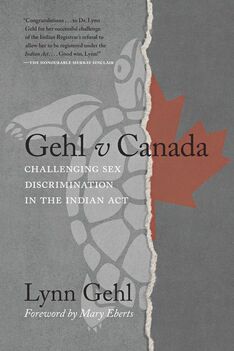 While many people may assume that when my court case ended and when the Gehl clauses were added to the Indian Act via Bill S-3 that my work on sex discrimination ceased. It did not. For the last few years I have been working with a group of women inclusive of First Nations women leaders, organizations and allies, and Canada’s senior feminist experts on Indian Act sex discrimination. This group is observing, advocating, and stressing for the need for Canada to more quickly implement Bill S-3. They are also addressing other issues: the consequences of the discrimination, resolving the lingering differences between matrilineal and patrilineal lines of descendance, and the involuntary enfranchisement of women, and thus her children, when their husbands enfranchised. Of course I am always sure to raise issues that continue to exist since Gehl v Canada (2017) and the subsequent addition of the Gehl clauses to the Indian Act. In my goal of ensuring community people have access to information that they need, I offer an edited component of a recent document the working group created that specifically addresses situations of unknown and unstated paternity. It is incorrect to think that all children of unknown and unstated paternity will automatically become registered status Indians like the mother. Gehl v Canada did not solve all situations of unknown and unstated paternity. This is what the court and Canada does; they narrowly define legal remedies as tightly as possible as a measure to save money. First, as a reminder, when a status registered mother cannot, or will not, identify the father of her child, her child is treated as if they only have one status parent. If the mother has 6(1) status, she can pass on 6(2) status to her child. However, if the mother has only 6(2) status, her child is not entitled to status and is hit with the second-generation cut-off rule. Although the requirement that a mother provide the father’s name in order to demonstrate that he is a status person was modified through the Gehl case, evidentiary difficulties continue with Indigenous Services Canada’s unknown or unstated paternity rule. Today a mother is required to show, on a balance of probabilities, that the father is/was a status Indian in order for her child to have full status. If the mother is unable to meet the evidentiary requirement the child’s status is bumped down or the child may be denied status altogether. It is easy to reason that the difficulties of proof fall harshly on women; this is especially so for young girls who become pregnant. There are, for example, cases of complete unknown paternity where a father is not known to the mother, child, and grandchild because the child was conceived through sexual violence such as rape, gang rape, rape while unconscious due to rape drugs, sexual slavery, prostitution, or situations of multiple partners. Further, as many know, unstated paternity situations include unreported paternity, unrecognized paternity, unacknowledged paternity, or unestablished paternity, where a mother records the father’s name on the child’s birth registration form, yet he refuses to sign it because he needs to protect his standing in the community, and/or a marriage to another woman, and/or to avoid child support payments, and/or wishes to hide that he had sex (read rape) with a minor child. Unnamed paternity also happens when a woman or minor girl child cannot name the man due to issues of sexual abuse and incest. What is more, and disturbingly, some birth documents have been changed, or tampered with, sometimes more than once, by hospital or government officials to obscure paternity in cases of adoption, unmarried mothers, or other situations (Gehl, 2017). https://www.erudit.org/en/journals/fpcfr/2017-v12-n1-fpcfr06468/1082440ar/ And there is still more to discuss here. It is well understood that Indigenous people have a higher rate of disabilities, and further that Indigenous women and girls with disabilities are bigger targets of sexual abuse (Gehl, 2021). Some of these women and girls are unable to hear, see, or move to defend themselves and some become pregnant where the man (I opt not to call them fathers) are unable to be identified and thus named and placed on a child’s birth document. https://www.lynngehl.com/indigenous-women-and-girls-with-disabilities-are-bigger-targets-of-sexual-violence.html It is in these ways that the two-parent rule continues the male dominance of the registration system, because identifying the father requires his cooperation, which he can withhold without penalty. Finally on this topic, there is no indication that the files of persons who were denied status because of unstated or unknown paternity before the Bill S-3 changes were made are being reopened and reconsidered. As people can determine Canada has more work to do in meeting their reconciliation agenda.
5/26/2022 0 Comments Quilted Imperfections I know knowledge producers, that we call “artists” knowledge producers, who intentionally incorporate imperfections into their work as a reminder of the teaching that Creator does not always make things that are perfect, and that we need to value difference and diversity. As a late learner of reading and writing many people critique my spelling, grammar, sentence structure, and punctuation issues – yet they claim to love the teaching inherent in what I call “quilted imperfections”. Like many Indigenous people my life has been pretty miserable moving through the poverty, the neglect, the trauma ... . As a scavenging child my focus was on survival in terms of the physical and in terms of my safety. Thus, you can be sure many critical periods of learning passed by me. Today I have a PhD yet it seems that some people want me to now go back to grammar school because they have issues with my grammar and punctuation. The truth is I have no desire to learn to perfect the colonizer’s language anymore than I have. My next big project after Gehl v Canada is completing a manuscript on Canada’s Algonquin genocide. People really need to learn how to link teachings with lived reality, or as academics say link theory and practice. I love Indigenous knowledge; it teaches me so much.
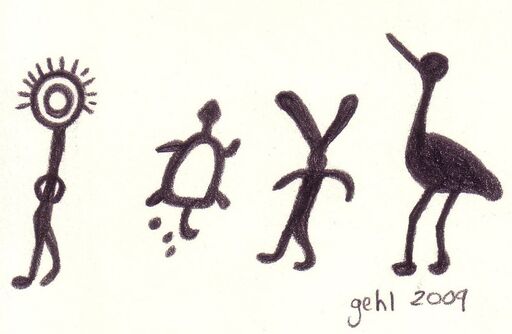 A 16th Century Algonquin Ancestor People who have 1 Algonquin ancestor from the 1600s are 4 centuries or 400 years away from this ancestor. Considering that in each 100 years there are 4 generations of lineage, a person of today is approximately a 16th generation descendant of the said Algonquin ancestor. Furthermore there were 400 years of intermarriage with other socio-cultural-ethnic-linguist peoples. This points to the reality that although you claim to be Algonquin, you are not. This is reasonable. The Deep Love of the Brown Brothers Thomas Brown and Robert Brown were brothers and best friends. They did everything together such as play, sing, dance, feast, and hunt. They were so close as brothers that they were married on the same day on July 1, 1779. Thomas Brown married a lovely Irish woman named Beth who became Beth Brown, and Robert Brown married a lovely Algonquin woman named Akik who became Akik Brown. Both marriages resulted in many children both boys and girls. These two families lived in the same town where every subsequent generation also had their own families who carried the Brown surname and many of them continued to live in the same town. The larger family network of cousins remained close and intact where through family folklore and stories the descendants of Thomas and Beth and the descendants of Robert and Akik all claimed that they had an Algonquin ancestor. This conflation is un-reasonable in that only the descendants of Akik Brown were genuine descendants of an Algonquin woman named Brown. The Creation of Identity Gaps and Traps All cultures contain a dense tapestry of rituals, dance, language, and foods that sustain them physically, emotionally, and spiritually. Sadly, with the emergence of state nationalism, where nation states destroy the cultural features and inherent deep meaning people need as they move through the world, a gap is created. In its place, state nationalism offers a thin veneer of culture such as a song and a flag. It is precisely because of this gap in deep cultural meaning and identity that too many settler peoples fall into the trap of usurping Algonquin identity. Performance as an Indigenous Way of Knowing Performance is a traditional Anishinaabeg way of coming to know and embodying knowledge. Performance is not solely defined as an explicit and consciously constructed story for a stage play. Not at all. Everything we do daily is a performance where the inherent activities and practices of the performance shape who we are and how we think. It is through the repetitive process of performing activities and practices that moves knowledge into our bodies which thus becomes embodied. This embodied knowledge then seeps into our subconscious, seeps into our hearts, and seeps into our dreams where through this embodiment we further become who we think we are. Today there are many settler people who, due to an identity gap created through state nationalism, have mistakenly stepped into administrative and leadership activities and practices of being Algonquin, where consequently they now think and feel and dream that they are genuinely Algonquin when they are not. The power of performance and embodied knowledge in these situations has become the trap many settler people are entangled in so much so that reason fails them. Author© Lynn Gehl, Ph.D. is an Algonquin Anishinaabe-Ikwe from the Ottawa River Valley. She is a member of Pikwàkanàgan First Nation She is a published author of Claiming Anishinaabe: Decolonizing the Human Spirit and The Truth that Wampum Tells: My Debwewin on the Algonquin Land Claims Process. Her most recent book is titled Gehl v Canada: Challenging Sex Discrimination in the Indian Act. You can reach her and see more of her work at www.lynngehl.com. 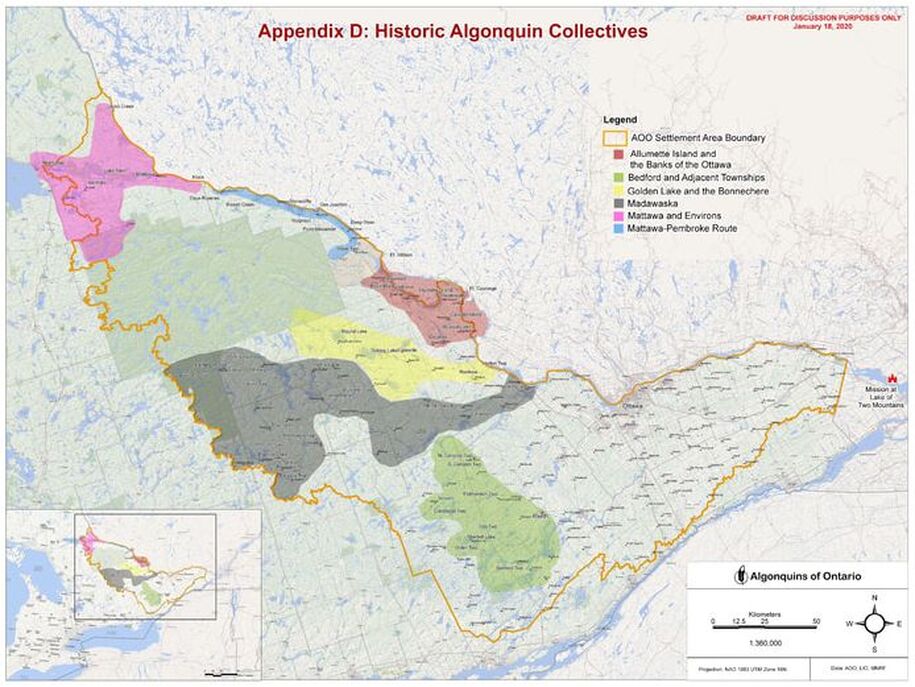 A Meandering Story: Truth, Evidence, and the Lack of Evidence Prior to contact the Anishinaabeg had a traditional practice of learning about people, who they were, and their integrity. Essentially we told each other stories about who we were. We told people our names, who are family members and relatives were, and we told them our clan. This practice provided us with the beginning of what could be or would be a trustworthy relationship. We had this ancient tradition because it spoke to the integrity of the person. In the modern context we now want to know what kind of education and training a person has, what they do for employment, and how they have lived their lives. This is reasonable. The Anishinaabeg tradition has always respected the greatest gift that Creator bestowed humans: our minds and our very ability to reason. Reasoning ability was respected and nurtured in our methods of parenting, teaching, and training. What I mean by this is parents and teachers value that individuals needed to develop their own ability to reason from within their being so much so that our methods of teaching are never didactic. Rather we always left room for the person to think through issues on their own. Respecting and nurturing an individual’s ability to reason was our way. European Enlightenment brought forward the idea and methodology of positivism, that truth is rooted in evidence such as scientific positivism where knowledge and truth is rooted in atoms and molecules, historical positivism where knowledge and truth is rooted in artifacts and archival documents, and legal positivism where knowledge and truth is rooted in evidence. In terms of legal positivism, when there is an absence of evidence judges use their training and minds and reason in their process of making a determination. This is what happened in Gehl v Canada. There was a lack of evidence and the judge reasoned through the community and family context of my father’s existence to determine he was and I was, like his mother, an Indian. This speaks to the need for critical thinking, and appreciation that the lack of evidence must be reasoned through. There is more to consider with the idea that truth is rooted in tangible evidence. Evidence, like truth, is shaped by assumptions about the world such as patriarchy and colonization and thus power where people with more power foremost become the producers of what is evidence. This means that critical thinking is required when considering what is evidence and what is not evidence. For example, people with power can and will create or manufacture evidence according to their own selfish needs. What is more, people with power can and will destroy evidence, and disturbingly some will even work hard to ensure that as they do corrupt things there is no evidence to be found. This speaks to the need for critical thinking, and appreciation that the presence of evidence and the lack of evidence must be reasoned through. As I say this no one should interpret me as saying that judges rooted in colonial law are able to determine truth. Clearly their assumptions are an issue. Most judges cannot come to a genuine and moral truth because Canada’s legal history emerges from the racist and genocidal Doctrine of Discovery. Again power mediates evidence, the lack of evidence, and truth. All this said, no one should interpret that I am suggesting that in the absence of evidence we just accept the person as Indigenous. Not at all because after all the very absence of evidence can itself be manufactured. What is more, when this so-called absence of evidence exists within a broader context where there is the creation of fraudulent archival documents doubt is reasonable. Again, Creator gave us the ability to reason, and Canada’s court system also relies on the ability to reason. The issue with the excuse that a person lacks evidence of who they are as an Indigenous person is limited. Canada began conducting census-taking as early as the year 1666 and it was as early as the year 1765 when Canada began recording if a family was Indigenous. Also, it was in 1871 when Canada began to take census every ten years. Another source is the Jesuit Relations beginning in 1631 through 1673. If you cannot prove you are Algonquin, you should not be enrolled in the land claims process. You should not be shaping the process in a leadership role and you should not be afforded the right or responsibility to vote on the final agreement. Rather, harness your integrity and walk away. When the time comes and the agreement is final you can then submit a community application and that community can rely on their own criteria set to determine if you are to be accepted as a member. This is easy to reason. Creator bestowed you with this skill within your being.  © Lynn Gehl, Ph.D. is an Algonquin Anishinaabe-Ikwe from the Ottawa River Valley. She is a member of Pikwàkanàgan First Nation She is a published author of Claiming Anishinaabe: Decolonizing the Human Spirit and The Truth that Wampum Tells: My Debwewin on the Algonquin Land Claims Process. Her most recent book is titled Gehl v Canada: Challenging Sex Discrimination in the Indian Act. You can reach her and see more of her work at www.lynngehl.com. Bare with me as I troubleshoot a new tool disseminating my blogs. Kwey Kwey Friends and Family, Please stand with me on this crucial human rights issue. In the last several months I have been working on Indigenous women and girls with disabilities (#IWadWig) who are bigger targets of sexual violence. I completed a 90 page report that is now publicly available here: www.lynngehl.com/indigenous-women-and-girls-with-disabilities-are-bigger-targets-of-sexual-violence.html More recently I submitted a written statement to the United Nations 79th General Discussion Session on CEDAW; and I was granted permission to offer an “oral intervention” on the topic. The actual date of the UN session is June 24, due to issues around my vision disability I pre-recorded my three-minute statement. See below. Indigenous women and girls with disabilities are living a life of intersectional oppression and what I call “Triple Jeopardy Magnified”. Many are unable to defend themselves against sexual violence because they cannot see, hear, run, or move. Canada, and all Canadians really, need to do more to protect these Indigenous women and girls. They have the right to be free from sexual violence. https://www.youtube.com/watch?v=-SKT8pUDXBc
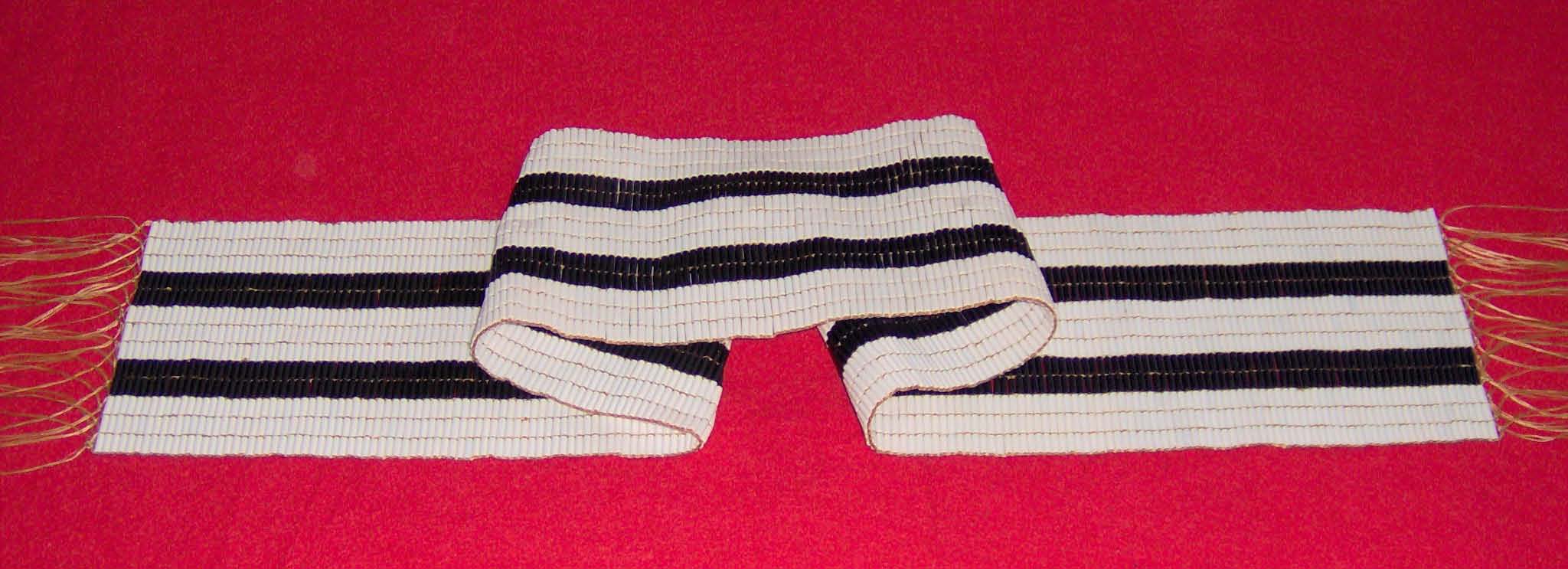 © Art and Image by Lynn Gehl Regarding Illegitimate Algonquin Identity Claims In the context of ongoing colonial genocide through the Algonquin land claims process in Ontario, and Canada’s broader municipalization of First Nation communities that continues to deny land and resources, it is especially important for people claiming to be Indigenous or who are portraying themselves to be Algonquin Anishinaabe to clearly substantiate their identity beyond that of the oral tradition and beyond that of an ancestor who was, or might have been, Algonquin in the 1600s, 1700s, or 1800s. The traditional protocol is that we clearly state who we are and how we are related to one another. In the current context of Algonquin genocide there are administrators, professors, teachers, language speakers, artists, ceremonialists, funders, chiefs, elders, heads of families, and cultural gate keepers who in their positions have access to power, yet they are not the Algonquin they claim to be or who they portray themselves to be. For that matter some are not even Indigenous. Portraying as Algonquin is the Worst Remember, and offering an example, being a language speaker in itself does not mean a person is Indigenous or Algonquin. Not at all. Language is foremost a social process. We need to keep in mind that many of the fur traders picked up the Anishinaabemowin language as it was the language of the fur trade. The same applies with picking up a jingle dress, a pipe, or an Eagle feather. It is about a misuse of power The biggest problem with people claiming to be Algonquin when they are not is that they are usurping and appropriating important positions, space, and resources in the process of making decisions on important topics, yet they lack a genuine legitimate Algonquin voice, where as such they are unable to shape, guide, or direct knowledge production, change, resurgence, and resistance in ways that are legitimately and genuinely Algonquin. Because they have less conviction, internal fortitude, and commitment in who they are claiming to be as Algonquin, these individuals become the tokens of powerful institutions because they are, and will be, more accommodating and obliging employees of the institution’s agenda. They will be easier to manage and manipulate because, ultimately, they are more needful in their identity claim. It is precisely in this way that they are interfering and harming legitimate Algonquin agency and direction forward. These people who do not have the conviction of who they claim to be, or who they portray themselves to be, are interfering with Algonquin recovery and sovereignty efforts. This is contrary to the Two Row non-interfering philosophy. It is about protecting our sovereignty In offering this important critical thinking it must be kept in mind that just because some Algonquin are standing up and asking you to be clear about the identity you are claiming, or portraying to be, this does not mean we are identity policing, being unkind, suffering from internalized oppression, or flourishing lateral violence. Not at all. We are asking the question because our very framework understands how institutional power is used to manipulate people who have less conviction in who they are claiming to be. It does not matter if they are your friend As the Algonquin struggle to move forward within the context of genocide it may be a good idea to think to yourself that just because someone is a friend, did a good thing for you, or is doing work that you like, this in itself does not mean they are Algonquin. Please do not allow your subjectivity to interfere with who and who is not a legitimate Algonquin, and do not default to the notion that we are “identity policing” and engaging in lateral violence. We are not! While I understand universal truths do not exist, and I understand that blood and community essentialism have huge limitations, and I understand the non-sense of the Status versus non-Status, and I understand that Indigenous nations adopted and assimilated new members into their nations, and I also understand that a “race shifting framework” is different than a “social identity framework”, within the context of ongoing Algonquin genocide illegitimately usurping Algonquin identity is really harmful. If you cannot stand with conviction in who you claim to be as an Algonquin, or who you are portraying yourself to be, it is asked that you stop appropriating an Algonquin identity because you are harming the Algonquin.
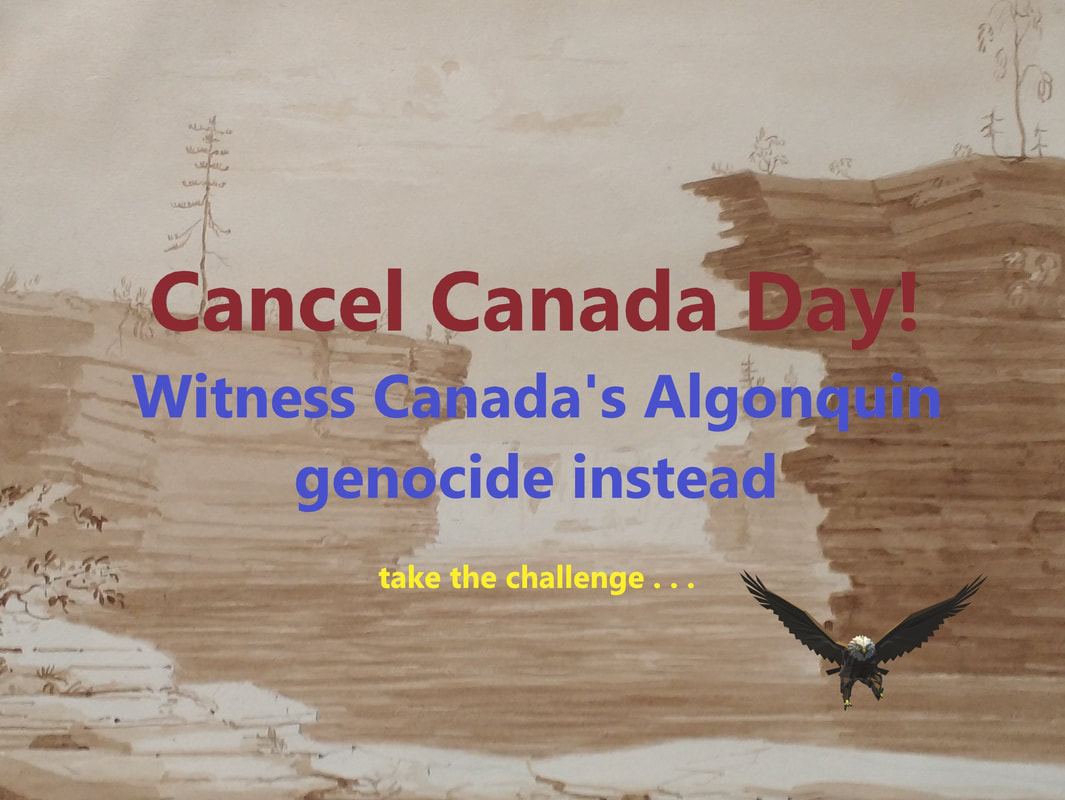 Akikpautik - Creator's First Sacred Pipe - Just upstream from Canada's Parliament Buildings - A site of grave desecration Although Canada the nation State’s parliamentary base illegally squats on Algonquin Anishinaabeg traditional territory, inclusive of its House of Commons, its Senate Chamber, the Governor General and the Prime Minister’s residence, and the Supreme Court of Canada, very few Canadians know who the Algonquin Anishinaabeg are. We are still here! Many Canadians do not know that the Algonquin Anishinaabeg were one of the first Indigenous nations recorded by Samuel de Champlain, nor do they know that through the creation of Canada, the British pitted the Algonquin and the French against one another when they gave the French colony Algonquin land. Yes, this is what the British did! This was an act of reprimand on the part of the British because the Algonquin were allies with the French. This action on the part of the British continues to undermine Algonquin sovereignty efforts today. The Algonquin have been divided by the provincial federal order, language, law, and religion. In addition, the Algonquin have been divided through the imposition of the reserve system and the Indian Act where as a result some communities today are federally recognized First Nation communities and others are not, and where some are registered Status Indians and others are not. What is more, some of our traditional communities and subsistence lands were flooded, or converted into provincial parks for the social, physical, and entertainment activity of the Canadian citizenry. Through these means of power, a Canadian cultural hegemony (read oppressive power) was established. Despite this historic genocide, what many Canadians also do not know is that this genocide continues in an evergreen way. Yes, this is correct. What Canada calls the “modern treaty process” is in fact a land claims process that forces economically impoverished First Nation communities and their Status membership, inclusive of the more disenfranchised non-Status Algonquin, to relinquish their land and resource rights. There are several reasons why Canadians are not knowledgeable about the historic and ongoing evergreen Algonquin genocide. One reason is because the governments of Canada control the school curriculum, a curriculum that creates a foundation of ignorance versus truth. A second reason is because Canada manipulates the mindsets and hearts of the Canadian citizenry through song, art, museums, monuments, provincial park recreational activity, and the news media inclusive of social media. A third reason is that incoming prime ministers place their party’s political power and money behind electoral candidates who are accommodating and obliging because they will be the token cabinet ministers and members of parliament needed to control (through party whipping) and perpetuate the evergreen genocide against Indigenous people. While Canada has been manipulating the mindsets of its citizenry in these ways, Canadians need to come to the place of valuing that when it comes to understanding the truth of Canada’s history, the locus of control is best understood as internal, meaning individuals hold and manage the jurisdiction of their own agency and thus read, think, and learn what they want to or need to. Cancel Your Canada Day Celebrations! Witness Canada’s Algonquin Genocide Instead. Take the time needed to learn about how it is that the Algonquin Anishinaabe today are facing genocide through the land claims and self government processes. Compiled below is a series of news articles that I have written (one is collaborative). Once you have completed these readings, let me know and I will send you a certificate of completion: “I completed the Algonquin challenge: Witnessing Canada’s Algonquin Genocide”. See below.
 Indigenous knowledge (IK) understands and talks about knowledge in a different way. It is valued that the primary portals of knowledge into who we are as human beings are our feet, hands, body, heart, and then after this the mind and reason. That is why we teach children through practice dance, song, and prayer before they are able to understand freedom of their own consciousness and thought, and thus, who they are as a human being. This very embodied knowledge gained through the practices of their feet, hands, body, and heart will then serve them when they are depressed or when they are grieving; meaning when their mind fails them their body will “remember” what they need to do. This is the life medicine of good embodied knowledge. When people talk about trauma and/or intergenerational trauma, they are talking about the negative embodied knowledge that has been ascribed on their being, their bodies, through various pitiful human acts such as physical and sexual violence and demoralization. What happens in the situation of trauma is that in the place where good knowledge should be ascribed, the trauma knowledge is placed or located. The trauma becomes landscaped on, and within, the body and this is what is more easily “remembered” because the body is more familiar with the trauma knowledge versus the medicine of good knowledge. As stated, the body is the more important repository of knowledge; versus the mind and reason. Growing up in a context where a mother loathes her children, because under the oppressive patriarchal industrial economic rule she had too many children, and worse no resources to care for them, what happens is this woman’s children become more familiar with her practices of loathe and disdain. In short, loathe is ascribed on the body of, or embodied on, the children where love should have been ascribed and embodied. This means the children will be more familiar with loathe so much so that they will confuse it with love. This trauma embodied knowledge is why so many women and men are "attracted" to the wrong partner and repeat the silly things humans do to one another. This "attraction" will continue until they do their most important work of looking deeply at the role their embodied knowledge has had in shaping their life, and they learn how to govern or manage the trauma of their embodied knowledge the best way they can. Lastly, when a persons embodied knowledge is trauma, the person has to constantly be aware of it, walk around it, and manage it so they do not repeat it or fall into its trap. At all times their mind has to be especially attuned to it. 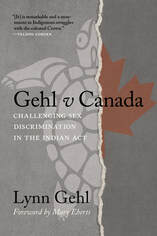 © Lynn Gehl, Ph.D. is an Algonquin Anishinaabe-kwe from the Ottawa River Valley. Her most recent book Gehl v Canada is now available for pre-orders: https://uofrpress.ca/Books/G/Gehl-v-Canada 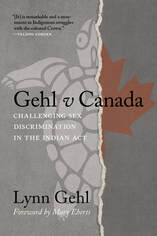 Gehl v Canada (Fall 2021) Gehl v Canada (Fall 2021) My Algonquin Anishinaabe identity flows through my father, his mother, and her parents (my great-grandparents). Through learning who I am I can also link myself to the people who lived at the Lake of Two Mountains and thus to pre-contact relatives. Me saying that I can link to the historic community of the Lake of Two Mountains and pre-contact relatives does not mean my Algonquin identity, that I claim, merely comes from an ancestor that lived in the 1700s. Not at all. I am clear about my identity coming from my father. Please do not misunderstand what I am saying or cherry pick back to pre-contact times. What is more, while through Gehl v Canada today I am a registered status Indian I really do not have a community where I feel I am embraced. For one thing, I cannot go and live at Pikwakanagan First Nation as there is not enough space and, even if there was, I am not sure I would be welcomed by the people. What I have become, through Gehl v Canada, is a name on a membership list versus existing within a community. It is clear to me that my father’s, grandmother’s, and great-grandparents’ community has been greatly harmed by colonization and genocide. This is why I do the work that I do. My allegiance is with my kin relations. I, though, am “fortunate” in the sense that the land where some of my extended kin relations now exist was not relocated or flooded, and that my great-grandmother with her mother (my great-great-grandmother) opted to move to a reserve. But the reality is that not all Algonquins in Ontario and Quebec wanted to go to reserve communities, and mixed bloods were not welcomed, or for that matter were pushed out of the community when they “married-out”. This was part of the genocide process. My point here is that just as DNA and a blood line have limitations, community essentialism also has many limitations. Identity is more than about being welcomed to a community or having a community. This is especially so when we appreciate that through colonization many communities and community relationships have been destroyed. What I have are kin relations with a particular community. I always had these kin relations as my father made sure he passed on to me these kinship stories, best known in the language as “gi-nwendaagininaanig dbaajimowinan”. Now that I have status registration as per the Indian Act things are not that much different. While the kin relations are there I would not say I belong to a community. Genocide happened; and genocide continues to happen such as through the land claims process. Certainly the struggle Indigenous people are having regarding identity is difficult and heart breaking. Well, it is heart breaking for me. What is making it worse is all the settler academics and people jumping on board with who, and what is, in vogue. In doing this, settlers interfere with the Indigenous process of figuring it out; well, hopefully working it out. All this is not to say that I am not appreciative of the needed critical analysis of settlers claiming to be metis for the sole purpose of gaining Indigenous rights, and also appreciative of the needed critical analysis of settlers claiming to be Algonquin for the purpose of gaining rights through the land claims process – a land claims process that will only serve to extinguish Algonquin land and resource rights. It is important for us to remember that historically, prior to contact, Indigenous nations adopted, assimilated, kidnapped, and nurtured new members into our communities. Through rituals such as initiations, dancing, ceremony, feasting, and loving kindness we socialized people into being new citizens of our Indigenous nations. While belonging was a blood process, we also valued the medicine of genetic diversity, and we also understood that belonging was very much a social process that was more about loyalty to the nation. Through genocidal laws, policies, and practices the nation state of Canada took all these inclusive processes of establishing our citizenries away from us; yet at the same time Canada appropriated the cultural process of socializing new citizens into their nation. What I mean by this is that by usurping Indigenous land and resources Canada is able to embrace refugees and immigrants as new citizens of its nation. In this process Canada relies on Indigenous land and resources to socialize its new citizens into being good, obliging, loving, and loyal Canadians. Minister Maryam Monsef is one such celebrated Canadian citizen that the current prime minister likes to hold up as a success story. The socio-cultural processes and rituals that Canada relies on consist of such things as manipulating their minds by controlling the school curriculum and filling their hearts through the daily ritual of singing O Canada. Other mechanisms used to socialize new citizens of the Canadian nation consist of skewing media stories, offering national awards to accommodating people, creating provincial and national parks, filling national museums with state propaganda, and, to ensure the completion of hegemony, the ongoing creation and manipulation of national symbols and icons such as the Canadian flag and creating national monuments of acceptable heroes. As Canada does this, creating new citizens of the state, Indigenous people fight about DNA and blood essentialism, fight about community belonging essentialism, and for that matter fight about cultural continuity essentialism, all the while forgetting about their own practices of inclusion. I know that DNA and blood, community belonging, and for that matter that even cultural continuity all have limitations. What is more important is kinship connections, loyalty, and allegiance. Lastly, sadly Canada has pushed Indigenous people to the point where we have forgotten that in its anthropomorphic form, and after the human spirit has moved through the heart, morality, inclusive of loving kindness, takes that same heart pathway. 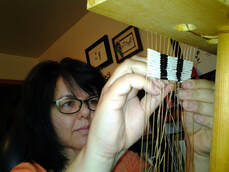 © Lynn Gehl, Ph.D. is an Algonquin Anishinaabe-kwe from the Ottawa River Valley. Her most recent book Gehl v Canada is now available for pre-orders: https://uofrpress.ca/Books/G/Gehl-v-Canada |
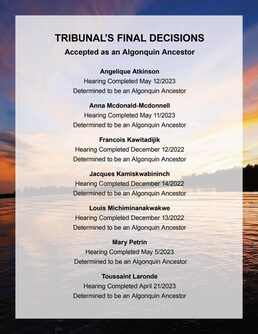
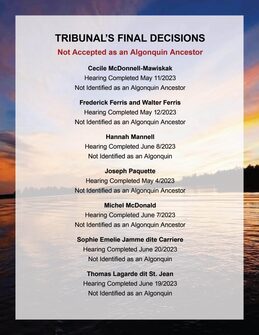
 RSS Feed
|
To subscribe to Lynn's Blog: click here
To subscribe to Lynn's Newsletter: click here To follow Lynn on her Public Facebook Page: click here To subscribe to Lynn's YouTube channel: click here To book Lynn as a speaker: click here To contact Lynn/License her work: click here Copyright Dr. Lynn Gehl, 2024 All Rights Reserved
|

|