|
10/4/2016 0 Comments Clearing the Smoke on the Water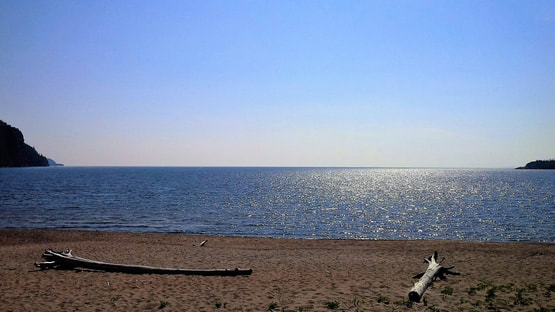 Old Woman Bay Lake Superior Photograph credit: Georgie Horton-Baptiste There are at least five layers of water pollution: 1 Debris such as plastic, glass, tires, planes, cars ... 2 Toxic metals such as mercury, lead ... 3 Toxic organic such as dioxins, pesticides, herbicides ... 4 Sewage and biological waste. 5 Radioactive particles. People should never be satisfied with the corporate deception of development through "greening up" a space such as removing old buildings, adding sod, and planting trees. The eye must not be allowed to appropriate reality. Like reality, most of the pollution is invisible to the eye. Ask a blind person. They know.  Lynn Gehl, Ph.D. is an Algonquin Anishinaabe-kwe from the Ottawa River Valley. She has a section 15 Charter challenge regarding the continued sex discrimination in The Indian Act, and is an outspoken critic of the land claims process. Her book The Truth that Wampum Tells: My Debwewin of the Algonquin Land Claims Process offers an insider-Indigenous analysis of the Algonquin land claims process in Ontario. You can reach her through, and see more of her work at www.lynngehl.com.
0 Comments
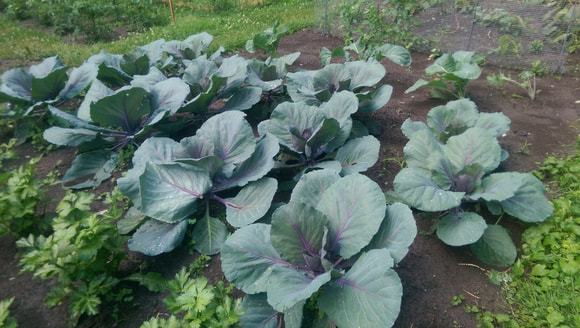 Why Does Joe Garden? A useful definition of hegemony is “knowledge” that is manufactured through oppressive power, or knowledge that is common to the people, rather than knowledge that is well thought-out ideology. A powerful example of the relationship between hegemony and material culture becomes apparent when we ask the question, “How is it that peasant societies are able to revolt?” Peasant societies are able to revolt because they do not rely totally on wage labour as they have alternate means of subsisting and surviving in the world. As a result, this means they are not materially dominated by the owners of their production as they have a dual relationship to the economy. Because of, and through, this dual relationship to the economy they are able to exercise their human agency and initiate revolution worldwide. They cannot be controlled by money losses. Another example of the relationship between hegemony and material culture becomes apparent when one asks, “Why are the working classes unable to successfully revolt?” Due to material domination and the relationship to ideological domination they cannot revolt because they have no alternate lifestyle to place their human agency into action. They are totally dependent on their income. Hence they are trapped, unlike members of peasant societies. 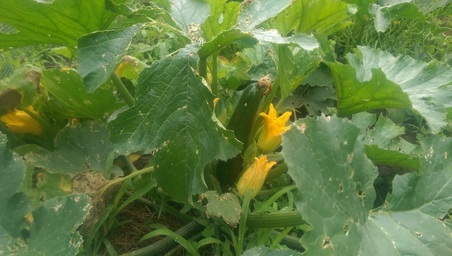 The Land is Intelligent and Makes Joe Think There is another interesting dynamic of hegemony within class domination of capitalism that becomes apparent when we ask, “How is the domination and subordination of the working class reproduced and sustained? It seems that most people are not puzzled by their lack of control over their lives, but rather mostly we actively and contradictorily express “resistance” to the very thinkers that could lead to our freedom in various ways. One way is through anti-intellectualism where as a result we prevent ourselves from developing a full critique and understanding of the structures of domination. Through anti-intellectualism we actually celebrate and perpetuate our domination, thus successfully preserving the status quo for our oppressors. In this way, as a force of hegemony, we further embed ourselves in the very world that we wish to escape from. 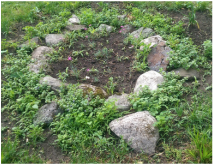 Other Ways the Oppressed “Celebrate” Their Oppression We celebrate hegemony and our oppression in many ways: through nationalism, shopping, silicone implants, inappropriate shoes, fashion slavery, Tim Hortons, purchasing on credit, diamond rings, endless materialism, big homes with big mortgages, and gluttony. Can you think of others ways? We need to learn from the turtle who teaches us there are two ways to get rich: one way is to work hard until you die hoarding a lot on the way, and the other way, which leads to ultimate freedom, is for us to desire little. The turtle is so smart. Note: This blog is influenced by the anthropological theory I was exposed to as an undergraduate student, in particular the work of Jean and John L. Comaroff and Tom Dunk. In the work regarding Indigenous rights I find my mind always moves in the direction of hegemony and anti-intellectualism where as such I decided to write this short blog. Please like and share this blog, and subscribe and donate. Miigwetch!  Lynn Gehl, Ph.D. is an Algonquin Anishinaabe-kwe from the Ottawa River Valley. She has a section 15 Charter challenge regarding the continued sex discrimination in The Indian Act, and is an outspoken critic of the land claims process. Her book The Truth that Wampum Tells: My Debwewin of the Algonquin Land Claims Process offers an insider-Indigenous analysis of the Algonquin land claims process in Ontario. You can reach her through, and see more of her work at www.lynngehl.com.
7/7/2016 4 Comments On Empowering Settler Allies …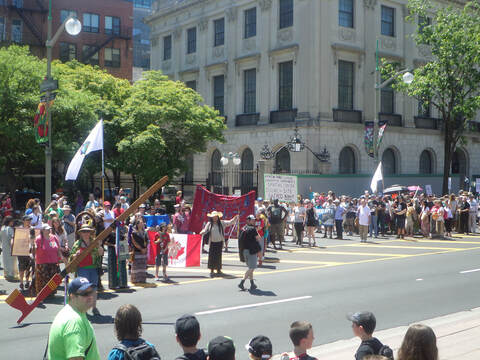 Sacred Walk Ottawa, June 17, 2016. Photo use with permission Matt Cicero Sacred Walk Ottawa, June 17, 2016. Photo use with permission Matt Cicero 1. The land claims process is an industry for lawyers and a job creation program for a few Algonquin people and nothing more. 2. Canada has huge amounts of money to craft policy and legislation that will forever prevent the Algonquin from unifying. The argument that the Algonquin must first come together before settlers act is incredibly misinformed and not at all rational. 3. Canada, like all oppressors, intentionally obfuscates and confounds things. Through this process oppressors gain agency in their oppressive acts. Do not fall for this. 4. Including oppressors, such as the police in your effort will thwart momentum. Make no mistake, it will. While at some point they may have a role in the final acceptance of structural change, this is near the end of the journey, not at the beginning. 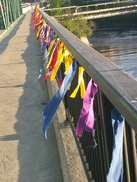 Prayer Ribbons Prayer Ribbons 5. Elders are ONLY one element of community governance traditions. It is community members – who have watched the child be socialized and shaped, grow up, and be valued as a person with good moral standing and integrity – who know who the genuine Elders are. Settler people need to stop interfering with identifying and calling people Elders. You do not have an Elder as in “my Elder”. If you want Indigenous people to get our act together, settlers must stay out of our traditions. Alternatively stated, Elderism has to end. For the most part Elders are for ceremony. 6. While sometimes an Elder is also an Intellectual, settlers need to understand that Indigenous communities also have philosophers and intellectuals. It will be the intellectuals that put concrete discourse to the policies and legislations that will motivate people and generate momentum. This is not a devaluation of Elders; it is an appreciation that Indigenous knowledge is also in the intellectuals. Alternatively stated, Elderism has to end. 7. All people are Indigenous to Mother Earth. Do not let oppressed Indigenous people who are laden with internalized oppression and lateral violence take this away. Settler people can, and must, stand up in a good kind way and defend their right to clean air, water, and land. We all have this responsibility. 8. Genuine action is not a festival, nor is it a tourist attraction, or a photographer’s / videographer’s opportunity. It is real hard work and some of us have been working on Indigenous rights for over 250 years. Yes, that is what I wrote, 250 years. 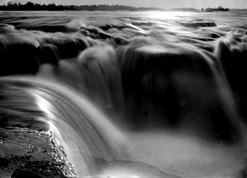 Chaudière Falls courtesy Lindsay Lambert Chaudière Falls courtesy Lindsay Lambert 9. Knowledge is not in the majority and not held in consensus. Sometimes the most important knowledge is in the one person or the minority. We must listen to all the voices paying attention to experiential knowledge, intellectual knowledge, and the person’s critical training to determine if hegemonic forces have placed the knowledge in the minority. Alternatively stated, stop allowing the tyranny of the majority and the need for a consensus thwart people’s needs. Always think critically; move away from criticizing. 10. Settlers need to act strategically and think about who they are creating space for. Local Indigenous people and their intellectuals need to be central, and an effort must be made to include them at all levels such as who speaks when and for how long, who is the master of ceremonies, who are the advisers, and who are the helpers … . 11. Know that oftentimes the most important knowledge is not flattering nor will it be candy-coated. In the context of structural oppression knowledge can and will be angry, frustrated, and depressed. If all you listen to is happy knowledge you are making a grave mistake. Generally speaking it is a good thing to look out for “nice” people as they very likely are manipulating you for personal gain. Listen to authentic people. As an example, if you do not like the knowledge in this blog, this in itself does not make it wrong. Learn to be more objective. 12. The argument that the best speakers are free is completely incorrect. Find speakers with the knowledge and support their hard work, time, thinking, and ideas. If what you want is genuine change, this Truth is a no-brainer. More ally resources are posted here. Please like and share this blog. Lynn Gehl, Ph.D. is an Algonquin Anishinaabe-kwe from the Ottawa River Valley. She has a section 15 Charter challenge regarding the continued sex discrimination in The Indian Act, and is an outspoken critic of the land claims process. Her book The Truth that Wampum Tells: My Debwewin of the Algonquin Land Claims Process offers an insider-Indigenous analysis of the Algonquin land claims process in Ontario. You can reach her through, and see more of her work at www.lynngehl.com.
My teacher Grandfather William Commanda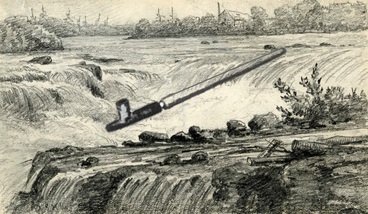 I was fortunate to have spent some time with the late Algonquin Anishinaabe Grandfather William Commanda (1913 - 2011), who lived in Maniwaki Quebec and who was the last keeper of three traditional wampum belts. Grandfather Commanda taught me via the oral tradition about the significance of the Chaudière Falls, best known as Akikpautik, located in the Kiji Sìbì, now known as the Ottawa River, and adjacent to Canada’s parliament buildings. He told me why Akikpautik – which translates to “Pipe Bowl Falls” – and the islands located just downstream are sacred. Interestingly the significance of Akikpautik was observed and recorded in 1613 in Champlain’s Journals where he witnessed the Anishinaabeg ceremonially offering tobacco to the pipe bowl. [see note 1]. This was before the time when settler people imprisoned Akikpautik within the cement walls of a huge hydroelectric dam. When reading Grandfather’s face, as he told me the story, I could feel that he was sad. While many Canadians understand the Ottawa River as the border between what colonial officials created and call the provinces of Ontario and Quebec, it must be appreciated that prior to contact the river was the uniting feature of the larger Algonquin Anishinaabe Nation who reside on both sides of the river. In addition, it must be appreciated that the river, Akikpautik, and the islands are indeed the jurisdiction of the larger Algonquin Anishinaabe Nation as we have never ceded or extinguished our land and water rights. I must stress here that this includes the much larger population of the non-status and the status Algonquin. Wìsakedjàk (Nanaboozo) and His Gifts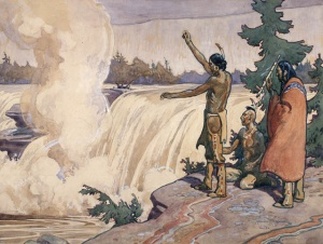 A central Anishinaabe figure and philosopher, Wìsakedjàk (also Nanaboozo), the son of the Spirit of the West Wind and Mother Earth’s first woman Winona, had many responsibilities, one of which was the naming all the beings on Mother Earth. Wìsakedjàk is also credited for bringing forth a special gift from his father, the First Sacred Pipe. As an Algonquin Anishinaabe-kwe community member rooted in my ancestral oral teachings I have heard that Wìsakedjàk’s footprints remain inscribed along the Ottawa River and so we know he was at Akikpautik. Many people know that Grandfather Commanda held a special vision and plan, “Asinabka the Sacred Chaudière Site”, that included re-naturalizing Pipe Bowl Falls and the three islands downstream. His plan included the removal of the large ring dam imposed, and the creation of a park, historic interpretive centre, peace building meeting site, and an Indigenous centre [see note 2 and 3]. But since capital trumps reconciliation between the Canadian state and Indigenous Nations, a well-supported development corporation known as The Windmill Development Group has momentum in moving ahead with building a “waterfront community” on this very sacred land and water space, despite sustained protests by community members, both Indigenous and settler people, as well as the opposition of most of the Algonquin Anishinaabe Chiefs in Quebec. These people want Grandfather’s plans to be implemented over more corporate destruction. Canada’s parliament buildings, the Prime Minister’s residence, the Governor General’s residence, and the entire National Capital Region reside on traditional Algonquin territory. As a result of this reality a major component of Canada’s nation-building strategy is dedicated to inventing and promoting a collective Canadian consciousness that rests on the erasure of Indigenous peoples and seizure of their territories [see note 4 and 5]. Sadly, many critical theorists realize that Canada has control and access to the resources to do this all too well. Canada's control of the resources is the very problem in that through this control they are able to manufacture a particular mindset that denies the need for valuing what is sacred. Indigenous Knowledge is in the Land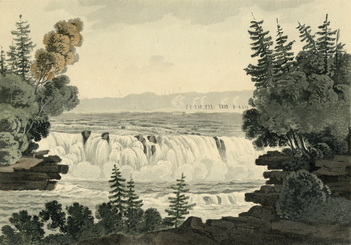 For Indigenous people our water and landscapes are very much storied as this is one way that we preserve important sacred beliefs, teachings, and knowledge for future generations to come. The short story is we want our descendants to embody and feel love for the land and the gifts it provides. For example, places such as Oiseau Rock, in Quebec, tell our story of Creation when the four sacred elements of rock, water, wind, and fire first came together. Through these stories we learn to honour the Earth for future generations. This is the very value of sacred beliefs; They are not trivial, silly, and primitive relics of the past that need to go away. In addition the location where waterways meet are valued as special meeting places in that it was through the gift of water that we were able to travel great distances to meet our relatives. One such location, situated between Quebec and Ontario, is in the Kiji Sìbì, where the Gatineau and Rideau Rivers join and where the three islands − Chaudière, Albert, and Victoria − are located downstream of the Chaudière Falls [see note 6 and 7]. Grandfather Commanda told me about the special features of Akikpautik / Chaudière Falls’ that have spiritual meaning for the Anishinaabeg, as well as for all the nearby and visiting Indigenous Nations such as the Cree and Blackfoot Nations. These features consist of a horseshoe falls, shaped as a near-circle (representing a pipe bowl); and an area where great amounts of water travel through an underwater cavern, re-emerging downstream (a pipe stem). The constriction of the river represents the narrowness of the pipe stem when it meets the bowl. Collectively, these features represent Creator’s First Sacred Pipe given to us by Wìsakedjàk [see note 8]. As I listened to Grandfather’s story my heart and mind swelled with pride and joy. This is what sacred stories and beliefs should do: fill you with the love of knowing how special you are, how special your ancestors are, and how special the land and water are. What I know for sureMeaning is not something you casually find on the ground. Rather, we are all born into meaning systems and socialized to love them. Unfortunately, power mediates the process where consequently oppressive cultures collapse sacred and moral meaning. In doing this they destroy the world. images of the sacred FallsNotes/links of interest: 1. Champlain, Samuel de. 2000. Algonquians, Hurons and Iroquois: Champlain Explores America 1603–1616. Edward Gaylord Bourne (ed.), Annie Nettleton Bourne (trans.). Dartmouth, NS: Book House Press 2. http://www.asinabka.com/geninfo.htm 3. http://ottawa.ca/calendar/ottawa/citycouncil/occ/2010/11-19/cpsc/02-%20report%20on%20the%20vision%20for%20the%20Askiabka.htm 4. http://www.un.org/esa/socdev/unpfii/documents/DRIPS_en.pdf 5. Gehl, L. (2014). The Truth That Wampum Tells: My Debwewin on the Algonquin Land Claims Process. Halifax and Winnipeg: Fernwood Publishing. 6. http://albertdumont.com/the-kettle-of-boiling-waters-chaudiere-falls-algonquin-territory/ 7. https://www.youtube.com/watch?v=UeFqbRBU5mk 8. Google Map Please share and like this blog. If you value my work and want to support it the donation button is below. Miigwetch.  Lynn Gehl, Ph.D. is an Algonquin Anishinaabe-kwe from the Ottawa River Valley. She has a section 15 Charter challenge regarding the continued sex discrimination in The Indian Act, and is an outspoken critic of the land claims process. Her book The Truth that Wampum Tells: My Debwewin of the Algonquin Land Claims Process offers an insider-Indigenous analysis of the Algonquin land claims process in Ontario. You can reach her through, and see more of her work at www.lynngehl.com. The TRC Identifies Three Forms of Genocide … . For over a century, the central goals of Canada’s Aboriginal policy were to eliminate Aboriginal governments; ignore Aboriginal rights; terminate the Treaties; and, through a process of assimilation, cause Aboriginal peoples to cease to exist as distinct legal, social, cultural, religious, and racial entities in Canada. The establishment and operation of residential schools were a central element of this policy, which can best be described as “cultural genocide.” Physical genocide is the mass killing of the members of a targeted group, and biological genocide is the destruction of the group’s reproductive capacity. Cultural genocide is the destruction of those structures and practices that allow the group to continue as a group. States that engage in cultural genocide set out to destroy the political and social institutions of the targeted group. Land is seized, and populations are forcibly transferred and their movement is restricted. Languages are banned. Spiritual leaders are persecuted, spiritual practices are forbidden, and objects of spiritual value are confiscated and destroyed. And, most significantly to the issue at hand, families are disrupted to prevent the transmission of cultural values and identity from one generation to the next. In its dealing with Aboriginal people, Canada did all these things. To read more: click here The Heartbreak of Algonquin Genocide ... . Eventually, after generations of petitions and only after we were in a particularly pitiful state of poverty and division, Canada entered into a land claims and self-government negotiation process with the Algonquin of Golden Lake, now Algonquin of Pikwàkanàgan First Nation. In this process only the Algonquin living in Ontario are involved, where through this process all Indian status members, approximately 1,800 members, are accepted as beneficiaries. So too are the approximately 6,000 non-status Algonquin accepted as beneficiaries. Through two federal government policies - the Comprehensive Land Claims Policy and the Inherent Rights Policy - our jurisdiction, land, and land related rights are not protected but rather continue to be denied and placed within the confines of a small b□x. Through these policies Canada has imposed on us what it thinks we are entitled to: a very small percentage of our traditional territory and a one-time buy-out. This deal was tabled in November 2012. Clearly 117,000 acres which amounts to only 1.3 per cent of our traditional territory and $300 million is a bad deal. To read more: http://rabble.ca/news/2013/03/heart-break-algonquin-genocide http://www.lynngehl.com/open-letter-to-prime-minister-justin-trudeau.html http://www.lynngehl.com/open-letter-to-dr-bennett.html Like and share this blog. 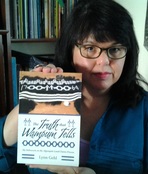 Lynn Gehl, Ph.D. is an Algonquin Anishinaabe-kwe from the Ottawa River Valley. She has a section 15 Charter challenge regarding the continued sex discrimination in The Indian Act, and is an outspoken critic of the Ontario Algonquin land claims and self-government process. She has three books: Anishinaabeg Stories: Featuring Petroglyphs, Petrographs, and Wampum Belts, The Truth that Wampum Tells: My Debwewin of the Algonquin Land Claims Process, and Mkadengwe: Sharing Canada's Colonial Process through Black Face Methodology. You can reach her at lynngehl@gmail.com and see more of her work at www.lynngehl.com.
2/16/2016 2 Comments On the Algonquin VoteRegarding this coverage: http://aptn.ca/news/2016/02/11/non-aboriginals-on-list-of-ontario-algonquins-set-to-vote-on-treaty-deal-covering-ottawa-report/ The Algonquin land claims settlement is a pitiful settlement: $300 million one-time buy-out and 1.3% of our traditional territory. We need to focus on this and stop with the identity politics. I am a non-status Algonquin in Ontario. Many people know I have a long standing Charter challenge about the issue of unknown and unstated paternity and the Indian Act. I completed my Masters work on Indigenous identity and so I am well versed on the issues related to Indigenous identity politics. I also completed my doctoral work on the Algonquin land claims processing where I decided to walk away from it because I learned it is rooted in colonial policy that serves the nation state of Canada and not Indigenous Nations. Like all Algonquins in Ontario I went through the lengthy and rigorous Algonquin Enrolment Law process which requires Algonquin link themselves to an ancestor on an official list. There are many issues with the ancestral list in that they have been shaped by census records and thus patriarchy, and also there is the issue that many Indigenous people know who they are via the oral tradition. It must be valued that many Algonquin had to push who they were underground to survive the onslaught of colonization. Further it must be valued that despite our ancestors’ efforts only one reserve community was created: Pikwakanagan First Nation. These realities, though, do not mean that non-status people are not Algonquin. Of course we are Algonquin. It was precisely for these reasons that an additional mechanism was put in place in the land claims to make sure the process was inclusive of all Algonquin. While I am no fan of the land claims process this inclusivity was a good thing. Yes, there was a time in the Algonquin land claims process where some “leaders” began to manipulate the Algonquin Enrolment Law process with hunting rights in their favour so they would be voted in as a representative and thus gain a paycheck from the process. While I could talk more about this, I cannot do it here as it requires a lengthy discussion. I posted links below for people who are interested in learning more. It is important to know that eventually many people enrolled, and whose identities were not confirmed rigorously, had to undergo a hearing to determine if they would remain included. It is my understanding that eventually approximately 300 people were removed from the Algonquin Enrolment Law process where as such they cannot vote on the final agreement. When Quebec chiefs argue the larger body of non-status Algonquin in Ontario are not real Aboriginal people when in fact it is well known that there are more non-status than status Algonquin they offer a critique that has many limitations and an argument that can be easily discredited. The real issue and critique must focus on the colonial policies that set us up for pitiful settlements. Alternatively stated, while I stand with the Algonquin Chiefs on the horrors of the land claims process, we need to focus on the termination of Indigenous rights and jurisdiction through unilaterally constructed colonial polices, rather than engage in a process of discrediting Indigenous people with a weak understanding and argument of identity politics. What is more, it should not be assumed that non-status people will vote yes. I am hearing that many are voting no. I am sure the same applies to the status Algonquin. I am hopeful that this vote is successfully ratified as a no vote. This is where my tobacco offerings are directed toward. #truththatwampumtells Related links: http://rabble.ca/news/2013/03/heart-break-algonquin-genocide https://ricochet.media/en/318/first-nations-finance-their-own-demise-through-land-claims-process http://www.lynngehl.com/black-face-blogging/long-live-the-algonquin-frauds http://www.lynngehl.com/2-truth-that-wampum-tells.html http://www.lynngehl.com/talking-radical-radio.html http://indigenouswaves.com/2013/07/17/dr-lynn-gehl-on-ally-responsibility-community-citizenship-treaties-indigenous-knowledge/ Please like and share this blog. 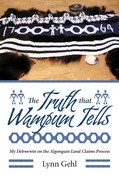 Lynn Gehl, Ph.D. is an Algonquin Anishinaabe-kwe from the Ottawa River Valley. She has a section 15 Charter challenge regarding the continued sex discrimination in The Indian Act, and is an outspoken critic of the Ontario Algonquin land claims and self-government process. She has three books: Anishinaabeg Stories: Featuring Petroglyphs, Petrographs, and Wampum Belts, The Truth that Wampum Tells: My Debwewin of the Algonquin Land Claims Process, and Mkadengwe: Sharing Canada's Colonial Process through Black Face Methodology. You can reach her at lynngehl@gmail.com and see more of her work at www.lynngehl.com.
 In this short video and recent article - http://linkis.com/nationalpost.com/36W4R- dated January 15, 2016, professor Akhavan offers a narrow understanding of what is genocide and then he proceeds to argue Indigenous people of Turtle Island don’t really understand the United Nations Convention for the Prevention and Punishment of the Crime of Genocide. I have a few issues with his reasoning as it is presented. First, a professor of law as he is, Akhavan roots genocide in intent with this statement: “provided the specific genocidal intent was in place”. Intent is too narrow a place to locate the practice of genocide. Placing knowledge, and consequently genocide, in the mind or in one’s intent is a myopic understanding of what knowledge is and where knowledge is located. It is well understood that proponents of western positivism of law and science must awaken to the limitations of their own knowledge paradigm. Clearly it is not working, especially so for the water and the trees and the other beings, never mind what it is doing to humans. This should come as no surprize in that western positivism is manmade law. Second, a professor of law as he is, Akhavan is unable to perceive the cultural aspects of genocide as it is written in the United Nations Convention for the Prevention and Punishment for the Crime of Genocide. While subsection (a) discusses direct killing, the UN definition moves on to talk about cultural aspects of genocide, thus expanding the definition beyond that of direct killing: (b) Causing serious bodily or mental harm to members of the group; (c) Deliberately inflicting on the group conditions of life calculated to bring about its physical destruction in whole or in part; (d) Imposing measures intended to prevent births within the group; and (e) Forcibly transferring children of the group to another group. While the word “culture” may not be in the text, cultural elements of genocide are inherent. Culture is all that humans are. Culture is much more than icons and books as the news article suggests. Culture includes the laws, policies, and institutions that humans create. Without cultural teachings, knowledge, and structures we are not human at all. Cultural genocide is genocide in that it is culture that makes us human. Cultural genocide, as it is placed within Canadian laws and policies, such as the land claims policy which forces Indigenous Nations to extinguish our jurisdiction and rights, and Aboriginal Affairs’ unstated paternity policy which assumes unstated fathers are non-Indians, are much more insidious and devious forms of genocide. They are more insidious and devious in that many people are unable to perceive them for the genocide they are where, as such, the genocide is able to go on and on and on. Third, in making the argument that the recent use of the concept “cultural genocide” was more about a need for recognition and mourning is offensive and incorrect. Akhavan is incredibly assumptive in his analysis. Akhavan assumes Indigenous thinkers, ceremonialists, traditionalists, scholars, and philosophers are unable to really understand what they mean when they use the concept “cultural genocide”. This assumption in itself is an act of colonialism. Law is not a science that seeks to understand the nature of the human condition and as such law, as it is defined by western positivism, needs to move over and allow other knowledge systems the space required in the discussion of what is genocide. For more of my thoughts on genocide and cultural genocide: http://www.lynngehl.com/black-face-blogging/the-insidious-nature-of-cultural-genocide Please like and share this blog. Miigwetch  Lynn Gehl, Ph.D. is an Algonquin Anishinaabe-kwe from the Ottawa River Valley. She has a section 15 Charter challenge regarding the continued sex discrimination in The Indian Act, and is an outspoken critic of the Ontario Algonquin land claims and self-government process. She has three books: Anishinaabeg Stories: Featuring Petroglyphs, Petrographs, and Wampum Belts, The Truth that Wampum Tells: My Debwewin of the Algonquin Land Claims Process, and Mkadengwe: Sharing Canada's Colonial Process through Black Face Methodology. You can reach her at lynngehl@gmail.com and see more of her work at www.lynngehl.com.
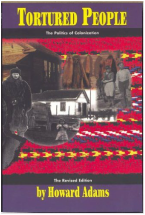 "If Natives had been left to themselves, the situation would naturally have led to direct action and a mass struggle for social change. By intervening with money, the government was able to determine the kind of politics that would be employed by grassroots Aboriginals." (64) "Canada is one of the most hypocritical and sanctimonious nations of the world. It is continuously bragging about its humanitarian services and peacekeeping efforts." (125) "Power over oppressed people can be maintained through 'non-decision' that is through silencing of voices before they are even heard. Ideas are smothered before they are even given consideration." (141) From Tortured People: The Politics of Colonization, 3rd Ed 2002 Like and share this blog post. Lynn Gehl, Ph.D. is an Algonquin Anishinaabe-kwe from the Ottawa River Valley. She has a section 15 Charter challenge regarding the continued sex discrimination in The Indian Act, and is an outspoken critic of the Ontario Algonquin land claims and self-government process. She has three books: Anishinaabeg Stories: Featuring Petroglyphs, Petrographs, and Wampum Belts, The Truth that Wampum Tells: My Debwewin of the Algonquin Land Claims Process, and Mkadengwe: Sharing Canada's Colonial Process through Black Face Methodology. You can reach her at lynngehl@gmail.com and see more of her work at www.lynngehl.com.
The Tradition of the Savage: Its Origins and Implications on Contemporary Indigenous Peoples’ Rights 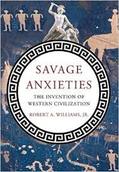 This lecture by legal scholar Robert A. Williams on his book titled “Savage Anxieties: The Invention of Western Civilization” is excellent. In fact, it is so excellent I have decided to annotate it and post it as a blog. Williams traces the invention of the discourse of the savage with its inherent practices back 3,000 years to Greek and Roman times where the definition consisted of a people who did not plough and plant food. It was through the invention of the savage that the Greeks and Romans structured their societies denying many their human rights to land and resources in the process. This discourse of the savage and subsequent practices is also the foundation of the Doctrine of Discovery which denies people who they are as human beings. Williams argues the 1763 Royal Proclamation, one of Canada’s founding constitutional documents, embodies this tradition of the savage, and as such the savage tradition remains a part of Canada’s constitutional jurisprudence; it is a part of Canada’s cultural DNA. Relying on the research he did for his book, Williams then argues that this tradition of the savage extends in very real ways into Canada’s Comprehensive Land Claims process. 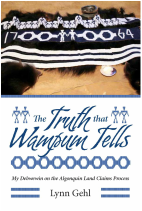 As I have in my book “The Truth That Wampum Tells: My Debwewin on The Algonquin Land Claims Process” Williams discusses in detail the Comprehensive Land Claims (CLC) process that First Nations involved in the British Columbia Treaty Commission and the Algonquin in Ontario of which Pikwakanagan First Nation is a part, are participating in. CLC processes result in nothing more than a contract, not a treaty, between a sovereign and their subjects. Under the CLC process First Nations are reduced to a municipal form of government and as such there is no real self-determination. Through the CLC process compensation and private lands are not on the table, and also First Nations are forced to pay back the provincial and federal loans required to negotiate for their own land and resource rights. It is through this federal land claims policy that the tradition of the savage continues to harm contemporary Indigenous people. 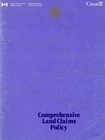 Despite CLC policy evolution, the blanket extinguishment policy has been changed to a modified rights policy that essentially means the same thing: nothing for Indigenous people. Clearly Canada is playing semantics with their policy adjustments where as a result domestic remedies have proven pathetic. This is precisely the reason why many First Nations will not participate in the CLC process and why others will not move past the Agreement in Principle stage because Canada refuses to abandon their savage policy. Williams further explains that when settlements under the CLC policy do result there is the issue of non-implementation on the part of the provinces and Canada. The Nisga’a Nation, for example, are in the process of suing Canada for failing to implement. In short, Canada does not even have the integrity to honour contemporary settlements once they are established. Williams also offers his analysis regarding Canada opting not to sign the United Nations Declaration on the Rights of Indigenous Peoples explaining that under the constitution of the United Nations general assembly, once a vote is cast, it is there forever. As such, even if Canada (read the Harper government) claims to have changed their mind on their vote, the bottom line is Canada continually refuses to comport their domestic law within international law which states the Doctrine of Discovery with its tradition of the savage is a racist doctrine from the colonial era that has no place in the 21st century. Interestingly, Williams ends the lecture arguing he has no confidence in the court process, both domestic or international. He argues it is best to publicize, through advocacy efforts, Indigenous human rights violations as the mechanism to pressure the governments to change their policies. Needed are aggressive human rights campaigns. You can subscribe to my blog here. Check your spam folder to verify it. Please like and share this blog. Miigwetch.  Lynn Gehl, Ph.D. is an Algonquin Anishinaabe-kwe from the Ottawa River Valley. She has a section 15 Charter challenge regarding the continued sex discrimination in The Indian Act, and is an outspoken critic of the Ontario Algonquin land claims and self-government process. She has three books: Anishinaabeg Stories: Featuring Petroglyphs, Petrographs, and Wampum Belts, The Truth that Wampum Tells: My Debwewin of the Algonquin Land Claims Process, and Mkadengwe: Sharing Canada's Colonial Process through Black Face Methodology. You can reach her at lynngehl@gmail.com and see more of her work at www.lynngehl.com.
 Cultural Genocide versus Mass Murder Genocide While many people are of the thought that we need to distinguish between what is cultural genocide, where a people are denied their culture, and mass murder genocide, where people are killed on mass, and further that cultural genocide is less destructive than mass murder genocide, this is a naive understanding and an erroneous analysis of what constitutes genocide and also the role that cultural teachings have in making us human beings. First and foremost it is important to acknowledge that Raphael Lemkin, the person who created the very term, defined genocide in socio-cultural-political terms as having two phases: one, the destruction of the national pattern of the oppressed group; and two, the imposition of the national pattern of the oppressor. Mass murder of a group of people is actually not a part of the definition. This is not to say mass murder is not genocide. Of course it is and both forms of genocide are included in the International Convention on the Prevention and Punishment of the Crime of Genocide: On the Word Choice of “Cultural” With the tabling of the Truth and Reconciliation Commission Executive Summary Report and Recommendations there is a buzz about the use of the word “cultural” when discussing genocide, as in it was cultural genocide. Many are of the thought that the use of the word “cultural” as an adjective to qualify the type of genocide that took place implies that a softer form of genocide and as such the word use offends them. These people also likely to argue there is no such thing as cultural genocide. Then there are other people who argue genocide is genocide, it really does not matter if the word “cultural” is used to denote what kind of genocide it was. Further, there are people who know that the use of the word “cultural” actually implies that the type of genocide that took place is a more systemic, all pervading, and thus omnipresent form, and as such adding the word “cultural” carries important meaning. Our Cultural Teachings; All that We Are The main difference between human animals and all the other beings is that humans are dependent on the cultural teachings and knowledge that our parents, grandparents, aunts, uncles, and community members pass on to us once we are born and as we grow up into adulthood. Without our cultural teachings we are not human beings. Rather, we are failed humans in that we are unable to move forward in a good way. Anishinaabeg cultural teachings, for example, guide us through the seven stages of life. These teachings are our medicines in that they serve to protect us from wandering off the path of life into dangerous directions such as places of extreme isolation, gluttony, materialism, and drug or alcohol addiction. 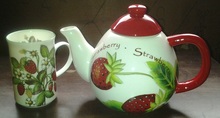 A Teapot Teaching of Cultural Knowledge As an Anishinaabe-kwe dedicated to honouring Anishinaabeg knowledge and dedicated to the process of creating new Anishinaabeg knowledge, my mind moves to what I call “A Teapot Teaching of Cultural Knowledge”. This teaching is short and simple, yet clear in what I want to convey about the role that culture has on the human condition. Our teachings are all that we are as a people. Our teachings are what make us the human beings that we are. In fact it is our dependence on cultural knowledge that differentiates us from the other animal beings and all the other beings. For example, moose and trees are so smart; they are born with all their knowledge. People, though, are like a ‘teapot of culture’ where once you pour out the cultural knowledge the people are gone. There may be a corporeal being but not much else as the people and their cultural teachings are synonymous. Again, our teachings are all that we are. At the same time people are not like a ‘teapot of culture’ where someone can pour out the cultural knowledge and simply pour in new cultural knowledge and stir. Again, when you pour out the cultural knowledge the people are gone. We need to remember that it is the formative years where we absorb our cultural teachings. 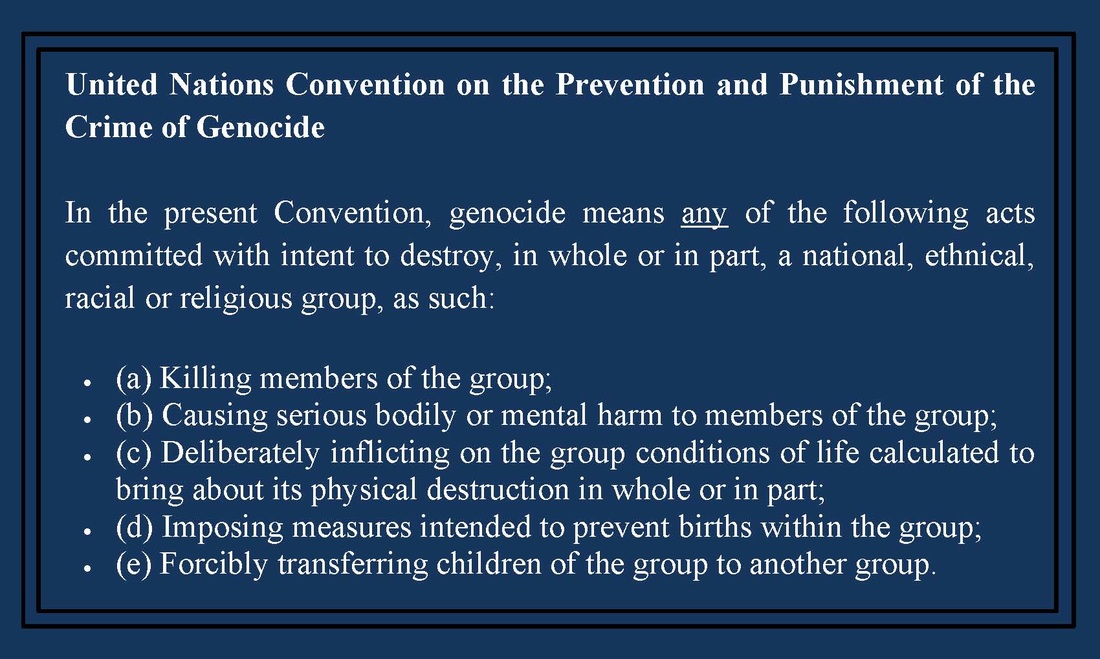 That said, for someone to suggest that mass murder genocide is worse, and as such the only definition of what is genocide, is to allow the eyes to appropriate and define what can be known, what becomes truth, and consequently what is reality. What I mean by “it allows the eyes to appropriate reality” is that in actual fact genocide achieved through the denial of a people’s cultural knowledge and teachings is much more slithery and insidious in the way it does what it is intended to do, that being terminate the people, yet it is harder to see and perceive. It is my view that genocide by cultural means is more insidious because most people, and for that matter popular culture in general, are unable to perceive and conceptually value the role that culture actually has in terms of making us the human beings we are, and also unable to value who it is that teaches people their cultural knowledge. Being unable to perceive and value the role of culture in a conceptual sense, and thus being unable to think critically about the role it has on shaping and making us the humans we are, results in a misconstrued view that a genocide that relies on destroying a people’s culture is a softer form of genocide, if it is genocide at all. Cultural Genocide Means Sinister not Softer So while people think it is important to distinguish between what is cultural genocide and what is mass murder genocide, because the latter is worse, a genocide through imposed cultural denial that occurs right in front of society’s eyes is in some ways more sinister in that it can go on and on and on and on, sometimes for centuries, in the form of culturally destructive, and thus genocidal, educational and health care systems. In fact it can be so insidious that the cultural genocide can be codified in law and policies such as the Indian Act and the Comprehensive Land Claims Policy that are imposed on Indigenous people. Cultural genocide is not softer, in actual fact it is more sinister. Genocide is Genocide I need to say one last thing on this topic. When someone offers the comparative argument that genocide by mass murder is the only genocide that exists because there is tangible proof and evidence, thus implying that genocide by cultural denial is not genocide because it is harder to prove as there is no real evidence, this is rooted in a very narrow understanding of what can be known, what becomes truth, and consequently what is reality. Western philosophy and its practices and processes of knowledge, such as what constitutes evidence and what is truth and reality, is no longer acceptable. It is making a mess of Mother Earth and all the beings, humans included. More enlightened people no longer value knowledge in these narrow terms. It is clear to me that University of Manitoba Professors Rodney E. Clifton and Hymie Rubenstein, and Conrad Black are all in need of enlightenment. To read their disgorge, versus some steeped tea wisdom, here are the links: http://news.nationalpost.com/full-comment/clifton-rubenstein-debunking-the-half-truths-and-exaggerations-in-the-truth-and-reconciliation-report http://news.nationalpost.com/full-comment/conrad-black-canadas-treatment-of-aboriginals-was-shameful-but-it-was-not-genocide  Lynn Gehl, Ph.D. is an Algonquin Anishinaabe-kwe from the Ottawa River Valley. She has a section 15 Charter challenge regarding the continued sex discrimination in The Indian Act, and is an outspoken critic of the Ontario Algonquin land claims and self-government process. She has three books: Anishinaabeg Stories: Featuring Petroglyphs, Petrographs, and Wampum Belts, The Truth that Wampum Tells: My Debwewin of the Algonquin Land Claims Process, and Mkadengwe: Sharing Canada's Colonial Process through Black Face Methodology. You can reach her at lynngehl@gmail.com and see more of her work at www.lynngehl.com.
3/15/2015 1 Comment Decolonizing DichotomiesWhile linear thinking and dichotomies do have limitations, sometimes they also serve a purpose in getting people to think outside the colonial box. Here is a list of words, terms, and phrases to think through in helping you decolonize your mind and as such move deeper into the Indigenous paradigm. Benefits / Rights Extinguish / Sharing Assimilation / Sovereignty Relinquish / Retain Land Claim / Treaty Culture / Philosophy Habit / Ritual Song as Entertainment / Song as Prayer and Medicine Volunteer / Responsibility Environment / Natural World Individual / Relational Agenda / Vision Mind / Body Humour / Medicine Reason / Wholism Talking / Listening Emotional / Women’s Wisdom Child Rearing / Governance Teachers Criticizing / Critical Thinking Written / Orality Economy / Morality Seven Days of Creation / Four Orders of Creation Owners / Settlers Take / Give Animals / Siblings Periodic Chart of Elements / The Sacred Elements Equality / Equity Unlimited Growth / Subsistence Religion / Way of life Stephan Harper / Elijah Harper Classes / Clans Knowledge is a Commodity / Knowledge Unfolds Superficial Meaning / Meaning is Layered Soldiers / Warriors Regime / Leadership Seniors / Elders Opinion / Wisdom Gossip / Oral tradition Competition / Co-operation Humanistic Tradition / Naturalistic Tradition Intelligence Quotation / Indigenous Knowledge Provincial Federalism / Treaty Federalism Resource / Respect Line / Circle Objective / Subjective Truth / truths Know / Perceive Borrowing / Cultural Appropriation Feminist / Indigenist 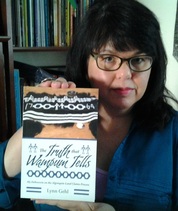 Lynn Gehl, Ph.D. is an Algonquin Anishinaabe-kwe from the Ottawa River Valley. She has a section 15 Charter challenge regarding the continued sex discrimination in The Indian Act, and is an outspoken critic of the Ontario Algonquin land claims and self-government process. She has three books: Anishinaabeg Stories: Featuring Petroglyphs, Petrographs, and Wampum Belts, The Truth that Wampum Tells: My Debwewin of the Algonquin Land Claims Process, and Mkadengwe: Sharing Canada's Colonial Process through Black Face Methodology. You can reach her at lynngehl@gmail.com and see more of her work at www.lynngehl.com.
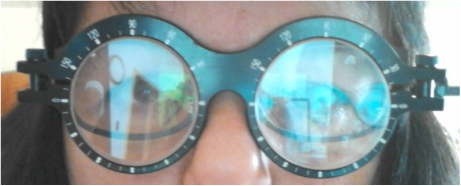 1. When someone tells you they have a vision disability, trust them. Do not begin to question them with doubt; or ask them to explain; or compare your poor refraction issues with their blindness. 2. Do not place a person with a vision disability in a situation where they have to tell you over and over and over and over and over and over and over and over and over again that they have a vision disability. 3. Value there are different types of blindness and that it is not the responsibility of the person who has a vision disability to explain them to you. Use your two eyes and read up on the different types on your own time. There are also videos that you can watch. 4. Do not you assume that just because the person does not use a white cane or dark glasses that they do not have a vision disability? Reflect on your assumptions. 5. When a person with a vision disability has a driver’s licence do not assume that they do not have a vision disability. Linear rationality, while sometimes useful, is an inadequate cognitive style to rely on all the time. 6. Do not assume a person with a vision disability is unable to see certain things better than you. In fact, some are able to see certain things that are otherwise invisible to a well sighted person. A large part of vision is embodied and subconscious. 7. When writing printed text use short clear complete sentences with a capital letter to begin the sentence and a period to end the sentence. This is a best practice that helps the reader in their process of extracting meaning out of text. 8. In the event that a person with a vision disability opts not to use capital letters or periods to frame their sentences, this should not be interpreted as if they are changing the rules of best practice in textual communication. It sometimes means their eye/s is/are exhausted and they trust that you will understand their limitations. Learn to deal with this contradiction. Again, linear rationality does not apply in all situations. What may be good for them may not be good for you. 9. Value that while sometimes their text will be well constructed, at other times it may not be. People who have vision disabilities sometimes do not want to use their eye/s to look over text, especially when it is not going to be published. 10. Do not judge them for their poor spelling and grammar. And do not assume that it is the result of laziness, sloppiness, and a lack of intelligence. Spelling and grammar are not at all the truth criteria of intelligence. 11. When they ask “What does that mean?” do not assume this question is intended as a slight against you or is a sarcastic statement. Some people with vision disabilities have difficulty extracting meaning from text and as such this is a common question they ask.  12. AVOID WRITING IN ALL CAPITAL LETTERS. While some people write entire sentences in capital letters, other people opt to add emphasis by capitalizing ONE word. This process is a barrier in that people have not learned how to read this type of text. 13. Avoid … the use of un-necessary ellipses … and exclamation points!!!! Again, many people have a hard time extracting meaning from text and this makes it harder. JUST … DON’T … DO … IT!!!!!! And really what the heck is this ~ anyway? 14. Avoid the use of bracketed text. (Instead make a new short sentence. This is best.) Unnecessary technicalities make reading harder. 15. When communicating with someone via text, consider that it may be best to number your points or questions in a clear and concise list. 16. When a person with a vision disability sends an email and their questions are numbered, take the time to respond to their questions with corresponding numbers. This will help them gain the clarity needed. 17. Instead of writing a lengthy email, pick up the telephone and call them. Many people with vision disabilities are isolated because pitiful societal structures such as policies, laws, as well as bricks and mortar institutions rooted in an economic paradigm created by able-bodied white people. 18. When the person is a writer, do not assume that this is an indication that they do not have a vision disability. 19. Always question whether you should frivolously send an article or book that you think they should read. 20. Do not assume a person who has misaligned eyes is intoxicated. Reserve judgement. 21. Understand that some people with vision disabilities may not like to have their photograph taken and if they do allow a photo to be taken be understanding when they request to see the photograph before it is published. This request is more than an ego issue. 22. Understand the subjective use of sunglasses. It really is none of your business. 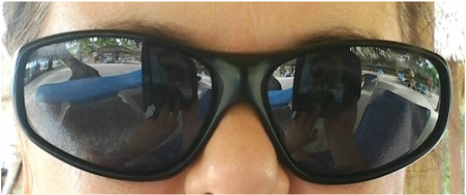 23. Get over your dislike for the word disability and your dislike when a person with a vision disability opts to use it. You can be sure that many are not thrilled with the word either. 24. Do not assume a person who uses the term disability does not know what their gifts are. 25. Understand that the use of the word disability does not mean they want to be pitied. 26. Do not assume a person with a vision disability is on a disability pension. 27. Understand that many of the expenses that a person with a vision disability has are not covered by insurance plans and in this way their medical expenses are higher even though their income, if they have one, is more likely than not less than average. 28. When a person with a vision disability bumps into you or falls down for what appears to be no reason at all, do not assume they are being abusive or that they are intoxicated. 29. When a person drops an item and it breaks or they make a mess such as their spilling coffee, do not assume it was because they were careless. 30. When cooking with a person with a vision disability allow things to get a little bit sloppy. Do not judge them for being careless. 31. Value that a vision disability, like many disabilities, manifests in fluid ways and as such shifts on a day to day basis. While things may be good on one day, they may be worse the next day. This is the way it is. Period. 32. Value that a vision disability, like all disabilities, synergistically interacts with other forms of structural oppression such as class, racism, and sexism. The sum total of the effect is always greater than the addition of the individual structural oppressions, making reality harder. 33. Understand that no two people have the same disability. Again, it is best to understand a disability as fluid, meaning it shifts from one person to another. A person who has more structural privilege will be better off than a person with less privilege. While a privileged white family may be able to afford a tutor and adaptive equipment, a poorer family will not. What is more, a white person with a disability navigates white structures where as such they will be better off than a person of colour with a disability. 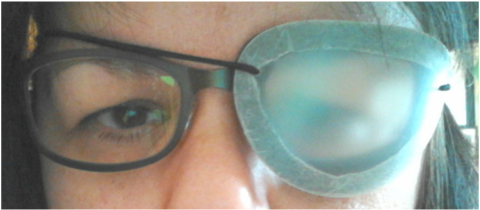 34. Value that when you engage in ableist ways you are also racist and sexist. Keep in mind that racial minorities, Indigenous people, and women, (especially women of colour and Indigenous women) have higher rates of disabilities. 35. Do not excuse your ableist ways with saying “that was not my intent”. It is now valued that intent is far too narrow a criterion for what is knowledge. Become informed and put the knowledge into concrete practice. 36. In the event that you are speaking to a family member of a person with a vision disability and they are not aware of the vision disability, do not assume the person is a liar. Many family members do not accept or understand the limitations of a disability that is not visible to the eyes. Family members do not always know what truth is. 37. Stop using ableist language in the metaphors you use when conveying ignorance. This includes, but not limited to, “are you blind” and “turning a blind eye”. People with vision disabilities are much more than what these offensive metaphors imply. 38. Keep in mind that people are gifted with two eyes, not just one eye, where the two eyes working together create three dimensional vision. Three dimension vision is much different than what a person with one eye sees. In this way, to reference “eye” rather than “eyes” is ableist language. 39. Keep in mind that people with vision disabilities are targeted by sexual offenders. This is because they are viewed as vulnerable, as well as because they are unable to see the abuser approach them. 40. Understand that many people with vision disabilities have skewed body postures that over time result in serious physical pain and deformations and as such further limitations. 41. When inviting a person with a vision disability to speak at an event rely on an intersectional framework in terms of the amount of time they are granted and in terms of covering their expenses. Remember equity not equality. 42. Always value an intersectional, meaning greater, level of understanding and compassion. People with vision disabilities, really any disability, are navigating structures that have been constructed for able-bodied white people. This means their everyday life experiences are particularly laden with ignorance, non-sense, assumptions, barriers, and expenses. Your level of understanding and compassion must adjust. 43. Do not add to their frustration and exhaustion with your selfish needs, ignorance, and exploitation of the knowledge that they embody. Sometimes you just need to listen and/or go away and think and read and learn in some other way. 44. Do your best to think critically and do not allow your eyes to appropriate reality. Value that things are much more complex than what you are able to see with your two eyes. Two really short (a few minutes) videos on what blindness can look like: https://www.youtube.com/watch?v=XvooNPvyvjo&feature=youtu.be https://www.youtube.com/watch?v=bHxxMUQDIwM Two articles on what is an intersectional framework: http://everydayfeminism.com/2015/01/why-our-feminism-must-be-intersectional/ http://www.huffingtonpost.com/gina-crosleycorcoran/explaining-white-privilege-to-a-broke-white-person_b_5269255.html Note: If there is a typo, grammatical error, or sentence structure error in my work and it is offending you greatly to the point that you are tempted to dismiss my knowledge offered and possibly even begin to poke at my education, please take the time to remind yourself not to be an ableist when reading about issues of colonization and structural oppression. Also keep in mind that inherent in ableism is both sexism and racism. Adopting an intersectional framework is a best practice approach when reading and learning. That said, please do not hesitate to report an error as this is always valued. Chi-Miigwetch  Lynn Gehl, Ph.D. is an Algonquin Anishinaabe-kwe from the Ottawa River Valley. She has a section 15 Charter challenge regarding the continued sex discrimination in The Indian Act, and is an outspoken critic of the Ontario Algonquin land claims and self-government process. She has three books: Anishinaabeg Stories: Featuring Petroglyphs, Petrographs, and Wampum Belts, The Truth that Wampum Tells: My Debwewin of the Algonquin Land Claims Process, and Mkadengwe: Sharing Canada's Colonial Process through Black Face Methodology. You can reach her at lynngehl@gmail.com and see more of her work at www.lynngehl.com.
2/10/2015 4 Comments Grandmother Moon Teaches Integrity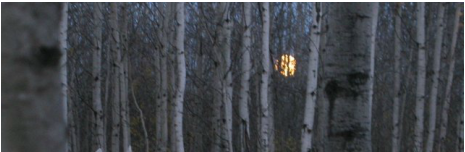 Photo credit Kathleen Yearwood There are many reasons why the Anishinaabeg trust grandmother moon and experience Her evocatively so. One reason is that She is consistent in Her way of always showing us the same side of who She is as a being of Creation. In this way She does not pretend and perform as many humans do. In always showing us the same side of who She is, She teaches us integrity. Questions that help decipher who has integrity 1. Do they treat other people differently than the way they treat you? Some people are only nice when they need you. This is a sure sign of a lack of integrity. 2. Do they treat other people in disrespectful ways or undermine another person for no real good reason? This is a sure sign of a lack of integrity. 3. Do they undermine knowledge holders through the use of unnecessary subtle comments and facial expressions? This is a sure sign of a lack of integrity. 4. Do they seek out nice people, thus avoiding hard core knowledge holders, to make it appear that they are serving the less fortunate and doing good work? Tokenism is a sure sign of a lack of integrity. 5. Do they demonstrate overly exaggerated disingenuous kindness to someone of authority yet not to other people? This is a sure sign of a lack of integrity. 6. Do they have any credentials or qualifications in the area they claim to have knowledge about or have expert knowledge of? 7. Do they self-identify as an ally? Like Eldership, this is not a title people claim. Rather, it is bestowed and continually achieved. 8. Do they appropriate an oppressed nation’s cultural icons and symbols for economic reasons? This is not acceptable. 9. If they are a woman, do they stand behind women and the work women do? They should. 10. Do they do what they say they are going to do? While it may not always be the case, the consistent inability to do so is a sure sign of a lack of integrity. 11. Do they share confidential knowledge that is not their knowledge to share? This is a sure sign that they should not be trusted. 12. Do their theories match their practices? Does a man who claims to care for the earth treat women well? If not, this is a sure sign of a lack of integrity. 13. If they are an advocate of human rights, do they practice an intersectional awareness and lens? If not, this is a sure sign of a lack of integrity. 14. Do they live with unchecked privilege? If so, this is a sign of a lack of integrity.  Lynn Gehl, Ph.D. is an Algonquin Anishinaabe-kwe from the Ottawa River Valley. She has a section 15 Charter challenge regarding the continued sex discrimination in The Indian Act, and is an outspoken critic of the Ontario Algonquin land claims and self-government process. She has three books: Anishinaabeg Stories: Featuring Petroglyphs, Petrographs, and Wampum Belts, The Truth that Wampum Tells: My Debwewin of the Algonquin Land Claims Process, and Mkadengwe: Sharing Canada's Colonial Process through Black Face Methodology. You can reach her at lynngehl@gmail.com and see more of her work at www.lynngehl.com.
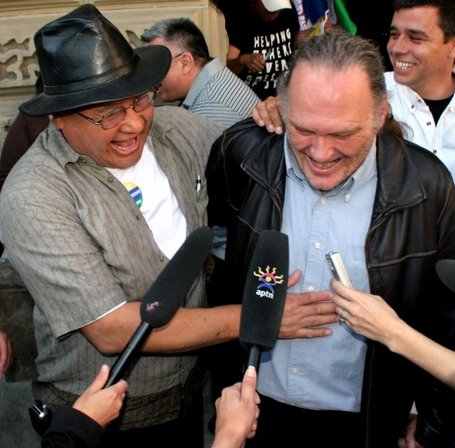 Bob Lovelace when released from prison, May 28, 2008 Photograph credit Susan Delisle Adoption or Allyship in the Contemporary Algonquin Context I am of the thought that in the contemporary context community adoption as a cultural practice must be reconsidered, where principled allyship is the better alternative. Otherwise, the practice of community adoption will exist only to be spun by spin doctors as the new form of interference. Learning through Introspection is Indigenous Before I begin it is important for me to offer that existing within the context of a section 15 Charter challenge, and within the context of the contemporary land claims and self-government process best known as a termination process (Russell Diabo), I have been exposed to some very grounded and puzzling human dynamics. When I introspect on these dynamics, and the things that puzzle me the most, sometimes knowledge emerges that will not be received well. Many people will not immediately understand the deeper meaning inherent and therefore will not understand why I offer my insights gained. Ultimately, knowledge is a relationship and as such I ask that readers take the time and establish a relationship to this knowledge rather than being quick to judge. We Adopted Historically Historically, Indigenous nations readily adopted other people into their nations in that, among other things, they greatly valued the alliance gained and the genetic diversity that came with the new members. While historically Indigenous nations adopted and assimilated other people, in a contemporary sense I have noticed that this practice of adoption embodies an undermining contradiction, and thus has limitations. I say this because in the contemporary context adopted people are challenged by jealous or dissenting community members and easily discredited as not really being speakers for the nation. In this process of discrediting adopted members it becomes apparent that they are not really accepted as full members. Outrageous Initiation Requirements I have found that when people are adopted they are placed in the situation where they have to do outrageous things, as a rite of passage so to speak, to prove their loyalty to the nation. This exists, I have noticed, as an unspoken requirement. One such example is the new member ends up in prison in defending the nation’s rights. Through these “initiation requirements”, these adopted people are vulnerable, become symbolic icons of the nation, yet contradictorily they lack the genuine power needed when speaking for pressing issues of the nation. Today We Discredit Adopted Members One of the most well known Algonquin today is retired Ardoch Algonquin First Nation and Allies Chief Robert (Bob) Lovelace, and rightly so as he has certainly proved his loyalty to the Algonquin and our land and waterscapes when in 2008 he went to prison to protect it from uranium mining and its ill effects. Lovelace has also encouraged and guided the production of several academic research projects that will serve future generations of Algonquin. It is important, though, that I point out here that as an adopted Algonquin Lovelace does not have the lived knowledge of being Algonquin since childhood, or the lived knowledge of being Algonquin inter-generationally speaking. Regardless, he does have knowledge of colonization and what it has done to the Algonquin. Despite his proven loyalty I have noticed that when Lovelace speaks up on Algonquin issues, many people – Algonquin included – are far too quick to discredit him as not really being an Algonquin in terms of his genetic material and blood lines. This is because we no longer really value adoption as a governance tradition. This situation of discrediting, I think, is a barrier and stifles Lovelace’s potential from doing what he could do best: speak out against the current Algonquin land claims and self-government settlement offer of 1.3% of the land and a $300 million one-time payment, and being heard and understood in a way that other Algonquin cannot. A Limiting Contradiction While this is the situation, at the same time many people gravitate toward Lovelace as a knowledge holder of Indigenous knowledge and truth - even on an international sense. Certainly in some ways he has been a teacher to me. It is in this way that he, and his adoption, embodies a very limiting contradiction, and it is in this way that in the contemporary context, adoption is a barrier to hearing what he has to say about Algonquin issues and concerns. It is precisely for this reason that it is my contention that principled allyship versus adoption is the better choice in the contemporary context. We need to remove the barriers that are silencing important voices such as Bob's. This blog requires a huge qualification. Robert Lovelace is an important person and his commitment to the Algonquin, Indigenous cause, and the earth is clear to me. This analysis should not be interpreted as me not valuing who he is and what he has done for the Algonquin. Lastly, it is Robert’s thought that I should offer this analysis. More precisely it is his thought that this blog could stimulate the needed discussion, which could then lead to collective thinking, where collective thinking could lead to consensus, and so on …  Lynn Gehl, Ph.D. is an Algonquin Anishinaabe-kwe from the Ottawa River Valley. She has a section 15 Charter challenge regarding the continued sex discrimination in The Indian Act, and is an outspoken critic of the Ontario Algonquin land claims and self-government process. She has three books: Anishinaabeg Stories: Featuring Petroglyphs, Petrographs, and Wampum Belts, The Truth that Wampum Tells: My Debwewin of the Algonquin Land Claims Process, and Mkadengwe: Sharing Canada's Colonial Process through Black Face Methodology. You can reach her at lynngehl@gmail.com and see more of her work at www.lynngehl.com.
1/20/2015 33 Comments That White Woman’s Gaze I had an experience that is telling in terms of a white woman’s interference in the relationship between Indigenous knowledge holders and Indigenous community members. I offer my story as it is illustrative of what many Indigenous women, Indigenous communities, and Indigenous organizations are contending with. It is worthy of noting here first, though, that this experience of mine happened within a very politically powered and gendered, and thus a very socially stratified, organization. White Woman Gaze Switching On this particular occasion I found myself in one of life’s special moments walking with an Indigenous elder and wisdom holder. Building relationships, I have come to know, sometimes take place in fleeting moments such as these. Walking side-by-side in the direction of the building we were heading toward, we exchanged small yet heartfelt pleasantries. As we entered the doorway and began to walk down the ramp deeper into the interior of the building a white woman was situated at the bottom of the ramp. This white woman looked at me and then at the elder and then back at me. My process of observing this woman looking back and forth was disturbingly telling. Through this process of observing her gaze-switching back and forth, I was able to observe how some white women look at Indigenous elders, in comparison to how they look at other Indigenous people such as me. As this white woman looked at me her face was pretty much neutral and not too expressive. Yet when her gaze shifted to look at the Indigenous elder her entire facial expression turned to one of juvenile happiness and joy. Again, when this white woman looked at me her face shifted to the more neutral expression. Then, as she once again shifted her gaze to look at the Indigenous elder, her facial expression once again shifted – again and again to one of childish adoration. By the time we made it to the bottom of the ramp, I had the opportunity to watch this cycle of her shifting gaze three times. How Her Gaze Switching Made Me Feel Although I knew this white woman, and I did have a somewhat friendly relationship with her, when we arrived at the bottom of the ramp, the Indigenous elder stopped to speak with this ever adoring fan. I, though, feeling ill, kept on walking. I was ill with disappointment because it was at that very moment that I realized I could never do for an Indigenous elder what this needful and pitiful white woman was able to do. Oh how I loathed this woman’s pitifulness, a pitifulness that any man would enjoy. As an Indigenous woman I have a right to, and need of, the Indigenous knowledge I seek. Indigenous communities are very much dependent on the emancipation of Indigenous women. The problem is that sometimes when we encounter elders we are unable to engage in the same pitiful childish adoring way that white women, and for that matter white men, are able to. And when our neutral facial expressions are compared to one such as this white woman’s expression, we are perceived as not deserving of the knowledge that may emerge. White Gaze of Interference When I think about my experience further, I recognize this white woman’s behaviour for what it is: an interference. Although there are many other reasons, a huge barrier in the transmission of Indigenous knowledge within Indigenous communities is what I call “white-woman-settler-gaze-of-interference”. This ramp experience with a white woman’s gaze was the moment when I realized how it is that white women are sometimes able to gain greater access to Indigenous knowledge than indigenous people. White women should not be impinging on the relationships that Indigenous knowledge holders have with Indigenous community members in this way. Indigenous people and Indigenous communities are dependent on the re-building of our nations and knowledge structures. Certainly, the white-woman-settler-gaze-of-interference should not be the mortar that solidifies and fortifies yet another inadequate patriarchy. Indigenous Women Are Vulnerable Enough In further thinking, I have also come to understand that within any organization where one resides at the lower end of the social stratification hierarchy, one is as vulnerable, if not more vulnerable, than the most vulnerable person. Clearly this white woman was needful and the problem is that through her pitifulness, she makes other people, such as myself, more pitiful as we are not able to compete in terms of offering juvenile adoration to an Indigenous knowledge holder. The Privilege of a White Woman’s Gaze Later I came to realize that in fact this white woman comes from a very privileged family and position in society. She has had, and continues to have, the love, support, and guidance of her parents, grew up in a home in a nice area of town, and thus had great access to economic resources. Regardless of her privileged position over Indigenous women this white woman is selfish. There is the Need to End the Selfishness of the White Woman’s Gaze White women, and white men, need to critically reflect on, and be cognizant of, their actions and respond in a way that assures they do not hurt Indigenous women and people in their emancipation efforts. In Indigenous women’s goal for emancipation we need genuine allies and collaborators, not women who interfere through their white-woman-settler-gaze-of-interference. Related Black Face Blogs: http://www.lynngehl.com/black-face-blogging/unhinging-settler-consciousness http://www.lynngehl.com/gehl-ally-bill-of-responsibilities.html http://www.lynngehl.com/black-face-blogging/on-indigenous-knowledge Feminist Wire article: http://thefeministwire.com/2013/04/clearing-the-path-for-the-turtle/ Lynn Gehl, Ph.D. is an Algonquin Anishinaabe-kwe from the Ottawa River Valley. She has a section 15 Charter challenge regarding the continued sex discrimination in The Indian Act, and is an outspoken critic of the Ontario Algonquin land claims and self-government process. She has three books: Anishinaabeg Stories: Featuring Petroglyphs, Petrographs, and Wampum Belts, The Truth that Wampum Tells: My Debwewin of the Algonquin Land Claims Process, and Mkadengwe: Sharing Canada's Colonial Process through Black Face Methodology. You can reach her at lynngehl@gmail.com and see more of her work at www.lynngehl.com.
 Shall I Bake a Cake? On this day − January 11, 2015 – of Sir John A. Macdonald’s 200th birthday anniversary I want to offer something special, something that may be remembered for the truth that Canada is. The Algonquin of Ontario offer After more than two decades since the Algonquin land claim was first accepted in 1991/2 as valid by the provincial and federal governments, it finally happened: the Algonquin of Ontario (AOO) agreement-in-principle (AIP), also known as a settlement offer, was finally tabled. The Algonquin Anishinaabeg are entitled to a pitiful 1.3% of our traditional territory, which amounts to 117,000 acres and a measly $300 million one-time buyout. Keep in mind here that the Department of Justice’s budget for 2014-15 is $662 million. I can’t and won’t read the AOO AIP. Reading policy, legislation, and legalese is not one of my gifts. There is no point in reading the details anyway. Let’s face it, it is only gaining access to land and resource rights that will lead to the emancipation of the Algonquin Anishinaabeg. I know many Algonquin people who have been, and some remain, both homeless and hungry. I also know many Algonquin Anishinaabe who have suffered, and continue to suffer, from the loss of their cultural meaning field. You can be sure that 1.3% of our traditional land base and $300 million is not going to resolve this suffering and make it go away. Harper, Taiaiake, Ladner, Diabo, and Palmater I am not alone in making this argument about the role of land and resources in Indigenous people’s ability to live a mino-pimadiziwin (good life). Elijah Harper, Alfred Taiaiake, Keria Ladner, Russell Diabo, and Pam Palmater, have argued this as well. We make this argument as we know it is only through land and resources that we will be able to set up meaningful institutions that are rooted in and emerge from our worldview. Honouring Indigenous Rights has Broader Implications It is no mystery that western cultural structures don’t work for us – and for that matter the rest of the natural world such as the water, the trees, the fish, and the birds included. I really need to add here that it should also be clear to everyone by now that the current economic model which lacks a moral code is inadequate for all people: heterosexual able-bodied white men included. Let’s face it, trees clean the air we breathe, and money is simply not nutritious. Yet, for some reason many people continue to think through an “us versus them”, meaning the Indians against the settler Canadians, cognitive model, and in this way they become complicit in their own domination. A Land Claims is Not a Class Action Unfortunately some people, Algonquin Anishinaabeg included, actually view the land claims process as analogous to a class action suit against a corporation such as Loblaws, where a final settlement is all that is required. Actually, these people have been encouraged to think of it through this line of pitiful reasoning. Through this, many people are inclined to think that $300 million is a good deal. Sir John A. Mcdonald, my parents and their children as all Algonquin Anishinaabeg deserve so much more. Resources Extracted To get a better handle on whether this is a good settlement offer one has to ask, as I have, “how does $300 million compare to the dollar amount of resources that have come out of Indigenous land?” Further, I have tossed these numbers around before and some people may be inclined to argue they are old and require updating, but who has the time? In the Indigenous knowledge tradition repetition is valued as an important and significant way of knowing. In 2005, the Ministry of Northern Development and Mines gained $4.8 billion from metals, such as cadmium, cobalt, copper, silver, and zinc from the land in southern Ontario. In the same year, $2.4 billion in non-metals, such as cement, clay products, lime, quartz, salt, soapstone, and stone, was extracted. That is billions of dollars in a single year folks. Remaining closer to Algonquin territory, during 2003 the forestry industry of Algonquin Provincial Park generated $152.8 million toward Ontario’s economy. In 2005, Algonquin Park alone generated $13.5 million from visitors, campers, concessions, and commercial leases. Further, in 1999, the estimated gross value of the hydroelectric energy produced by the Madawaska River system, a tributary of the Ottawa River, was worth about $45 million. In reviewing these numbers, one has to wonder what would these numbers total when considering the last 500 years of colonization? Although I am not sure there is such a thing, it is my guess the total number would be in the mega zillion dollar range. Okay, I admit maybe I am exaggerating here but for goodness sake, the point is Indigenous people have financed the construction of Canada and its settler population, yet benefited little in the process. Canada was built on the backs of Indigenous people. No thanks John A. Macdonald! Acreage Offered In terms of the acreage the Algonquin Anishinaabeg are offered, Algonquin Park consists of 1,891, 097 acres. This is sixteen times larger than the 117,000 acres offered to the Algonquin. There are seventeen provincial parks in Algonquin territory in Ontario. These parks include but are not limited to Silver Lake Provincial Park, Bonnechere Provincial Park, Bon Echo Provincial Park … . Canada, are you getting the idea here? I really hope so. Since the Algonquin land claims process began it has been plagued with racism, sexism, anti-intellectualism, a pitiful hunting interim agreement, faulty election processes, and White interference. Yes, that is right, White interference. When I reflect on this pitiful process it becomes more obvious to me that the land claims process is nothing more than a federal and provincial job creation project, where legal advisors, a few Indigenous people, and the Canadian government benefits at the expense of too many, mostly women and children. As an Algonquin Anishinaabe, Sir John A. Macdonald, I wonder how many good and loyal settler Canadians are set to celebrate the anniversary of your birthday, knowing this history of the country you founded? Rest assured, I won’t be baking a cake. Related Links: http://rabble.ca/news/2013/06/genocide-racism-and-canada-day-algonquin-anishinaabekwe-love-letter http://rabble.ca/news/2013/03/heart-break-algonquin-genocide https://canadiandimension.com/articles/view/canada-is-not-the-arbiter-of-what-is-genocide http://www.lynngehl.com/black-face-blogging/three-of-canadas-genocidal-policies http://anishinabeknews.ca/2014/11/27/algonquin-chiefs-say-tsilhqotin-supreme-court-decision-is-no-more-than-colonial-policy/  Lynn Gehl, Ph.D. is an Algonquin Anishinaabe-kwe from the Ottawa River Valley. She has a section 15 Charter challenge regarding the continued sex discrimination in The Indian Act, and is an outspoken critic of the Ontario Algonquin land claims and self-government process. She has three books: Anishinaabeg Stories: Featuring Petroglyphs, Petrographs, and Wampum Belts, The Truth that Wampum Tells: My Debwewin of the Algonquin Land Claims Process, and Mkadengwe: Sharing Canada's Colonial Process through Black Face Methodology. You can reach her at lynngehl@gmail.com and see more of her work at www.lynngehl.com.
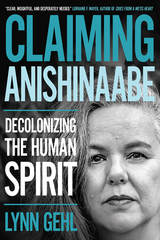 University of Regina Press University of Regina Press People are pondering and asking questions such as why it is that after 25 years not much has changed since the massacre of 14 engineering women in Montreal on December 6th, 1989. People, all people, need to return to our ancient Indigenous knowledge systems. We all have ancient knowledge systems that served to protect women and children, men, and the earth and all the gifts she provides. When I read Judy Rebick’s recent blog post where she reflects on the continuation of sexual violence, and her coming to the conclusion that the problem is deeply rooted in our culture where as such we have to go beyond changing the laws and our legal system and develop processes at the community level, I felt hopeful. Judy suggests we need to change our culture at the community level where institutional power is not found. This raises the question where is culture? We Need to Remember Our Culture If we want to eliminate oppressive patriarchy, misogyny, and its effects from our communities we need to return to the ancient practices that all (Red, Black, Yellow, and White) our ancestors relied on: The Indigenous knowledge systems that predated nation states such as Canada. Returning to Indigenous knowledge is the only way we will remove the violence done to women, children, and Mother Earth. Broadly speaking Indigenous knowledge is the knowledge that predates heteropatriarchy, sexism, racism, ableism, industrialization, corporate power, and materialism. Our Bodies Are Intelligent, Our Bodies Remember Knowledge comes to us through the practices our bodies do, and exits our bodies that way too. It is as simple as it is sophisticated: Indigenous social and moral codes operate through the embodiment of an internal locus of control. What I mean by this is that children and individuals are socialized in a way where we learn to govern our bodies and behaviour from the inside, rather than through the imposition of external apparatus such as police, fines, written laws, courtroom proceedings, judges, and prisons. It is as simple as it is sophisticated: Our voices, our bodies, our feet, our hands, our hearts, and the practices we do with them are both entrance portals as well as exit portals of knowledge, morals, and emotions such as anxiety, frustration, and anger. While most people are unable to value this truth, the very practices we are taught and socialized through, and with, are governance medicines. Indigenous knowledge systems consist of ancient stocks of knowledge and grounding practices such as chanting, songs, drumming, as well as ceremonies and rituals such as prayer, feasting, and dancing. Indigenous knowledge systems also consist of our daily household and community responsibilities such as sewing, knitting, beading, cooking, hunting, harvesting, carving, and wood chopping. Most people no longer value that these practices are medicines of protection and they ignore them. Regardless, they are just that. They are protection medicines in that they serve to shape and inform who we are, how we behave toward one another, how we move emotions outside our bodies and, for that matter, how we interact with and care for the natural world. Corporeal Knowledge is the Jurisdiction of Families and Communities, Not the Nation State In the Anishinaabeg Indigenous knowledge tradition mothers, fathers, extended family members, and community members − rather than schools and other such institutions of nation states − work hard to ensure that children are taught and socialized through the practices of song, ceremony, and ritual so that the knowledge becomes embodied within them in a deep and subconscious way while they are still young. While this knowledge is subconsciously landscaped and located within the soil of the child, it is not until they age and grow up when they move into a more conscious understanding of the knowledge of who they are as a self in relation to all else. It can be said it is not until they age when the knowledge germinates in a conscious sense of what knowledge is. When Our Minds Fail Us, Our Bodies Remember Through a long loving family and community socialization process this embodied knowledge of who they are as a human being; who they are within the network of community relationships; the importance of women, men, children, and elders in the community; and the importance of living in harmony and balance with people and the natural world remains there in a way so they can rely on it to guide their emotions and behaviour in times of stress, depression, anxiety, and anger. This embodied knowledge is also there guiding and comforting them as they cope with the death of family members and when they too pass into the spirit world. Through the subconscious embodiment the knowledge becomes who they are and all that they do. It becomes their default way of being that they are then able to rely on when they need it most. When their mind fails them, their bodies will remember who they are and what to do. What the Body Does, the Heart Feels, and the Minds Thinks While the western world thinks we learn through the mind, in the Indigenous world and contained within our ancient knowledge traditions and practices it is valued that what the body does, the heart feels, and the mind thinks. In this way, our body teaches and shapes our hearts and minds how to feel and think and act. The entire landscape of our bodies is where knowledge is first seeded, not our minds. These seeds are planted and germinated through cultural practices. Freud and Jung Freud offered the model of the iceberg as a way to explain the location – the tip of the iceberg – and smallness of human consciousness where the bulk of who we are as humans resides below the surface in the subconscious. Carl Jung offered the model of the cork floating in a huge sea, where the smallness of the cork represented human consciousness. I find these models useful in bringing to the minds of western peoples, or peoples who have not thought much about who we are as human beings, how little and insignificant our conscious minds really are. Our Body’s Memory, Not After-the-Fact Fixes When we learn to value how small our conscious minds are, the limitations of policies, laws, courts, and the prison system in guiding us forward as we struggle to be better people becomes more obvious. These external locus of government controls – external in that they are outside the landscapes of our bodies − are merely after-the-fact-fixes to the violence that as such do very little to curb the very thing they claim to do. This Knowledge is Protective Medicine Why is it that these after-the-fact-fixes are inadequate at helping us live as good and moral human beings? It is because they are external measures of control imposed on us after we have grown and after we already know, or more accurately don’t know, who we are as human beings. They are not embodied through loving, caring, family and community practices. Again, morals need to be subconsciously embodied in a kind, loving, non-judgemental, and fun way; subconsciously embodied in a way that they will always be with us as we age and grow; subconsciously embodied in a way that when our conscious minds fail us, or potentially misguide us, such as when we are anxious, depressed, stressed, angry, or sick and dying the knowledge will guide and protect us. This knowledge of who we are will be in our bodies. This corporeal knowledge will protect us and our communities in a way that external measures of government control cannot. In sum, the embodiment of our prayers, songs, dances, and so many other practices such as feasting, hunting, harvesting, sewing, and beading serve to guide and direct us to act as better human beings when we most need it. It is knowledge that Nation States Cannot Give and Should Never Take Away Our ancestral Indigenous knowledge systems are the cultural medicines that nation states, with their roots in patriarchy, the subjugation of women’s knowledge, misogyny, and the economic exploitation of the Earth, have worked hard to make many of us forget who we are as human beings. Today these same nation states are floundering at how to address the misogyny that is killing so many of our family and community girls and women, Indigenous women more so. It is as simple as it is sophisticated. All people need to remember their Indigenous knowledge systems. Our communities, women, children, and men deserve better than the misogyny that the state has imposed on our bodies and in our communities. Related Black Face Blog on Indigenous Knowledge: http://www.lynngehl.com/black-face-blogging/on-indigenous-knowledge http://www.lynngehl.com/my-indigenous-knowledge-protection-act.html http://rabble.ca/news/2013/06/genocide-racism-and-canada-day-algonquin-anishinaabekwe-love-letter http://www.lynngehl.com/black-face-blogging/caw-caw-caw-what-is-your-indigenous-knowledge  Lynn Gehl, Ph.D. is an Algonquin Anishinaabe-kwe from the Ottawa River Valley. She has a section 15 Charter challenge regarding the continued sex discrimination in The Indian Act, and is an outspoken critic of the Ontario Algonquin land claims and self-government process. She has three books: Anishinaabeg Stories: Featuring Petroglyphs, Petrographs, and Wampum Belts, The Truth that Wampum Tells: My Debwewin of the Algonquin Land Claims Process, and Mkadengwe: Sharing Canada's Colonial Process through Black Face Methodology. You can reach her at lynngehl@gmail.com and see more of her work at www.lynngehl.com.
12/1/2014 11 Comments Ghomeshi, the CBC’s Fifth Estate Interview, and Gossip versus the Oral Traditionwatched the Fifth Estate the other night. Chris Boyce, the Executive Director of CBC Radio was interviewed by Gillian Findlay about the Jian Ghomeshi matter. Like many I felt it was pretty good reporting but I think something was missed by the interviewer. This particular phenomenon is recurring, and while I am always quick to address it when I encounter it when talking with people, I have yet to write about it. Regardless of what many may think, all peoples are well vested in the oral tradition, not just the people of Turtle Island. We all talk and listen to one another, we all tell and listen to stories, we all listen to the natural elements such as the wind and rain. This use of the oral tradition continues today. We all listen to the radio, television, and music. The oral tradition has a long history that predates written language and what is recorded in the books, journals, and archives stored in our personal, public, and national libraries. In many ways it can be said the more important knowledge is the oral knowledge that circulates in our discussions that take place around the dinner table, our sidewalks, our coffee shops, and our places of work such as the lunch and board rooms. It is this oral knowledge that has not been “cleaned up” by higher powers and political agendas that houses many truths of who we are. When people and a nation began to define knowledge in legal positivistic terms relegating it to the written word, an artifact, or a criminal conviction, they did the oral tradition and the truths contained a disservice. When a nation of people began to do this, define knowledge through these narrow parameters, they put many, in particular women and children, in harm’s way. What really concerned me was the way the CBC executive responded when asked, and only after repeatedly being asked, if he knew of the Jian Ghomeshi abuse. His response was dismissive of the oral tradition stating “only through office gossip”. It was at this moment when the CBC executive spun very legitimate and valid oral knowledge into nothing worth listening to. While gossip has an interesting etymology worthy of learning, in the contemporary context it is crucial that we understand that gossip refers to the process of intentionally undermining a person through spreading malicious untruths about them. Gossip is intended to harm and discredit good people. Both men and women engage in the practice of gossip. It is not something that only women do. As a matter of fact I have witnessed men engage in gossip as a mechanism to see who they can rely on in their larger goal of undermining another person and gain power over. The knowledge sharing that takes place in our social spaces where we meet, such as coffee rooms and office hallways, is not gossip. It is the oral tradition. This particular CBC executive has been grossly misinformed about what is knowledge. In a world where people abuse their power, and where women are unwilling to move forward with a complaint due to issues of power and the narrow interpretation of evidence and truth, it is even more crucial that the oral tradition not be dismissed as mere gossip. Employers, such as this CBC executive, must learn to value the oral tradition and act to protect their employees.  Lynn Gehl is an Algonquin Anishinaabe-kwe from the Ottawa River Valley. She has a section 15 Charter challenge regarding the continued sex discrimination in The Indian Act, and is an outspoken critic of the Ontario Algonquin land claims and self-government process. She has three books: Anishinaabeg Stories: Featuring Petroglyphs, Petrographs, and Wampum Belts, The Truth that Wampum Tells: My Debwewin of the Algonquin Land Claims Process, and Mkadengwe: Sharing Canada's Colonial Process through Black Face Methodology. You can reach her at lynngehl@gmail.com and see more of her work at www.lynngehl.com.
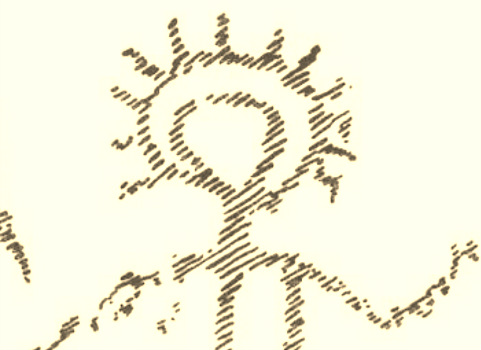 Are you an anti-intellectual?
Please like and share this blog.  Lynn Gehl is an Algonquin Anishinaabe-kwe from the Ottawa River Valley. She has a section 15 Charter challenge regarding the continued sex discrimination in The Indian Act, and is an outspoken critic of the Ontario Algonquin land claims and self-government process. She has three books: Anishinaabeg Stories: Featuring Petroglyphs, Petrographs, and Wampum Belts, The Truth that Wampum Tells: My Debwewin of the Algonquin Land Claims Process, and Mkadengwe: Sharing Canada's Colonial Process through Black Face Methodology. You can reach her at lynngehl@gmail.com and see more of her work at www.lynngehl.com.
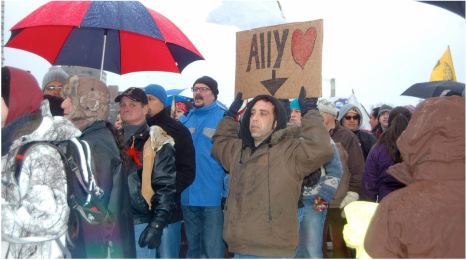 1. A colonized ally stands in the front. A decolonized ally stands behind. 2. A colonized ally stands behind an oppressive patriarchy. A decolonized ally stands behind women and children. 3. A colonized ally makes assumptions about the process. A decolonized ally values there may be principles in the process they are not aware of. 4. A colonized ally wants knowledge now! A decolonized ally values their own relationship to the knowledge. 5. A colonized ally finds an Indigenous token. A decolonized ally is more objective in the process. 6. A colonized ally equates their money and hard work on the land as meaning land ownership. A decolonized ally knows that land ownership is more about social hierarchy and privilege. 7. A colonized ally projects guilt. A decolonized ally knows it is their work to do. 8. A colonized ally projects emotions. A decolonized ally knows Indigenous people have too much to deal with already. 9. A colonized ally has no respect for Indigenous intellectuals. A decolonized ally knows Indigenous people have their own intellectuals. 10. A colonized ally has no idea they need to decolonize. A decolonized ally understands they have to continually decolonize. 11. A colonized ally has no idea of the concomitant realities of Indigenous oppression. A decolonized ally understands the many, layered, and intersectional oppressions Indigenous people live under. 12. A colonized ally speaks for Indigenous people. A decolonized ally listens. 13. A colonized ally takes on work an Indigenous person can do and is doing. A decolonized ally takes on other work that needs to be done. 14. A colonized ally makes things worse. A decolonized ally understands. 15. A colonized ally says, “It is time to get over it.” A decolonized ally realizes one’s relationship to the harm is subjective. 16. A colonized ally appropriates another nation’s Indigenous knowledge. A decolonized ally does the hard work to uncover their own Indigenous knowledge. 17. A colonized ally will loath this truth offered. A decolonized ally will recognize the hard work telling this truth is. Additional ally resources are available here  Lynn Gehl is an Algonquin Anishinaabe-kwe from the Ottawa River Valley. She has a section 15 Charter challenge regarding the continued sex discrimination in The Indian Act, and is an outspoken critic of the Ontario Algonquin land claims and self-government process. She recently published a book entitled Anishinaabeg Stories: Featuring Petroglyphs, Petrographs, and Wampum Belts, and her second book, The Truth that Wampum Tells: My Debwewin of the Algonquin Land Claims Process, will be published in March 2014. You can reach her at lynngehl@gmail.com and see more of her work at www.lynngehl.com.
Please like and share this blog.  On Paradigms ... Humans build paradigms to think through and gain guidance in our process of moving forward. While this is a good thing we need to value that paradigms are human constructions that also have limitations. All theories, models, terms, and constructs emerge from paradigms. When someone constructs a paradigm that excludes some knowledge, and then uses this same paradigm to deny this same excluded knowledge, they are making an error. The knowledge exists even if their new paradigm refuses to value it. When this same someone then pushes the knowledge she/he has excluded in their paradigm construction underground by ignoring, denying, or refuting it, they commit a grave disservice to the people whose knowledge they excluded when constructing their paradigm. Alternately, if someone creates a paradigm because the old paradigm is not representing all the knowledge and another person who only values the old paradigm and thus who exists outside the newly created paradigm argues through the narrow criteria of the old paradigm as a way to discredit the new paradigm – she/he is engaging in a paradigm error and completely missed the point of the new paradigm. The paradigms of western science and western economics that are narrowly rooted in objectivity, physical matter, linear progress, and profit are human made paradigms that have excluded the much needed element of the sacred in directing human thought and behaviour forward. Indigenous knowledge is the paradigm that we all need to re-value and return to. What is your Indigenous knowledge?  Dr. Lynn Gehl is an Algonquin Anishinaabe-kwe from the Ottawa River Valley. She has a section 15 Charter challenge regarding the continued sex discrimination in The Indian Act, she is an outspoken critic of the Ontario Algonquin land claims and self-government process, and she recently published a book titled Anishinaabeg Stories: Featuring Petroglyphs, Petrographs, and Wampum Belts. You can reach her at lynngehl@gmail.com and see more of her work at www.lynngehl.com.
Please like, share, and comment on this Black Face Blog.  Shaunna Neil, Curve Lake First Nation Shaunna Neil, Curve Lake First Nation The really lovely thing about strawberries is that their sweetness reminds us of what is important in life. The Anishinaabeg word for strawberry is ode’min and the exact translation is heart berry. It is called that because it is red and shaped like a heart. In the Anishinaabeg tradition the heart is an important repository of knowledge. Actually, in many ways the heart is a stronger and more intuitive repository of knowledge than the mind. After all, in terms of our intrauterine development we are a heart first. As a learner and thinker I value heart knowledge as a way of knowing so much so that I went through the painstaking process of developing it as a method at the doctoral level, and then proceeded to produce my knowledge − meaning my dissertation on the Algonquin land claims process − using it as part of my methodology. When I think about the heart as the more powerful repository of knowledge that it is, I realize that it holds the capacity to challenge and transcend how we usually understand time. The heart is able to collapse time, even intergenerationally passed time, into one single moment. Sometimes when we think back to a past time we feel the same as we felt back then. In this way the heart erases the time that has passed. Put another way, within human consciousness heart knowledge changes our usual understanding of time. Through the heart, time becomes relative. This is the power of heart knowledge that we all need to respect. In the work I do regarding Indigenous issues and nation rebuilding, I encounter a lot of people who have been hurt by the processes of colonization. Some of these people are very expressive of how they have been hurt. I have come to realize that we need to listen to these people and not make it worse by saying “get over it”. As humans it is our responsibility to listen and mirror in a good way. We are only people within relationships after all. I have encountered people who have been hurt by the residential school system, people who are spiritually disenfranchised because of the politics of Indigenous identity, and women who have been hurt by the fathers of their babies. Many people are also experiencing the hurt of drug and alcohol addiction in their families, as well as issues of homelessness. Then there is the contemporary land claims and self-government process, a process designed to continue the colonial agenda that sets up Indigenous people to fight amongst ourselves. Certainly I know first-hand that it is hard to be hopeful in this context. When I listen to Indigenous people talk about their heart knowledge that they experience, and I reflect and think about what they are saying, I have come to realize something significant. In my process of observation, listening, and critically reflecting on the effects of colonization on people I have come to realize that people have their own relationship with their embodied heart knowledge. Within a group of people there are different relationships to heart knowledge. While some people rely on the discourse of “I walked through the pain and heart ache”, other people rely on the discourse of “I decided to put it all behind me”. Still further, I have also heard other people say they “walk with their heart knowledge every day”. It remains with them in all they do. In sum, people have a relationship with their heart knowledge and we need to value this relationship, rather than assume that everyone gets over it or walks through it.  Lynn Gehl, Ph.D. is an Algonquin Anishinaabe-kwe from the Ottawa River Valley. She has a section 15 Charter challenge regarding the continued sex discrimination in The Indian Act, and is an outspoken critic of the Ontario Algonquin land claims and self-government process. She has three books: Anishinaabeg Stories: Featuring Petroglyphs, Petrographs, and Wampum Belts, The Truth that Wampum Tells: My Debwewin of the Algonquin Land Claims Process, and Mkadengwe: Sharing Canada's Colonial Process through Black Face Methodology. You can reach her at lynngehl@gmail.com and see more of her work at www.lynngehl.com.
Please like, share, and comment on this Black Face Blog. 11/22/2013 4 Comments Anishinaabeg Concept / Symbol of Truth (Debwewin) Adopted by Métis as Nation's Flag Prior to the European invasion, the Anishinaabeg held a lifeway and knowledge tradition that was very sophisticated. While change has occurred, many of these ways of knowing continue to exist. One such way of knowing is Debwewin Journey, a wholistic way of knowing and being that involves one’s heart and mind working together (Gehl, Debwewin Journey). This way of knowing is recorded in ancient Midewiwin scroll knowledge and is best described as two connecting circles: a circle of heart knowledge and a circle of mind knowledge. While the top circle represents mind knowledge, the bottom circle represents heart knowledge. In the Anishinaabeg tradition, knowledge is not considered a truth unless both heart and mind knowledge are working together. Heart knowledge void of mind knowledge, or mind knowledge void of heart knowledge, is left incomplete and is potentially dangerous knowledge. It is interesting to note here that this is the same symbol that the Métis have adopted as their national flag, adding a 90 degree turn to the symbol. Through processes of colonization, many Anishinaabeg today are struggling with embodied heart knowledge (the circle of heart knowledge), void of an intellectual understanding (the circle of mind knowledge) of what they feel. In the event that this happens to an individual, it is suggested that instead of reaching for drugs or alcohol, or some other pitiful alternative, that they go on a Debwewin Journey. Through Debwewin Journey, individuals travel far on a personal knowledge-seeking adventure where it is their responsibility to learn the history of colonization, such as the criminalization of our culture and the history of the oppressive and sexist Indian Act, for example. In learning the circle of mind knowledge and in connecting it to the circle of heart knowledge, an individual is able to come to a wholistic understanding of who they are and still the undercurrents that flow beneath their feet. .... This is chapter 7 from my book "Anishinaabeg Stories: Featuring Petroglyphs, Petrographs, and Wampum Belts". For a longer version of this story see: Reference: Gehl, Lynn. "Debwewin Journey: A Methodology and Model of Knowing." AlterNative 8.1 (2012): 53-65. To listen to a radio show interview and to purchase my book: Click here Chi-Miigwetch  Lynn Gehl, Ph.D. is an Algonquin Anishinaabe-kwe from the Ottawa River Valley. She has a section 15 Charter challenge regarding the continued sex discrimination in The Indian Act, and is an outspoken critic of the Ontario Algonquin land claims and self-government process. She has three books: Anishinaabeg Stories: Featuring Petroglyphs, Petrographs, and Wampum Belts, The Truth that Wampum Tells: My Debwewin of the Algonquin Land Claims Process, and Mkadengwe: Sharing Canada's Colonial Process through Black Face Methodology. You can reach her at lynngehl@gmail.com and see more of her work at www.lynngehl.com.
Please like, share, and comment on this Black Face Blog. 11/10/2013 13 Comments Two Things Genuine Allies Know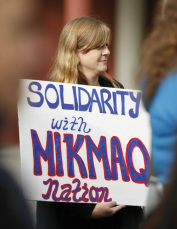 First: They Value Differences and Rather than Suggest they be Erased Genuine allies know that when people claim their differences within the social hierarchy of “white male heterosexual able-bodied” power, such as an Indigenous person or a person of colour, within the context of challenging the oppressive power structure, that this should not be perceived and argued as being divisive and thus disruptive to the larger goal and needed solidarity. Genuine allies know we are only humans within relationships of good social mirroring and affirmation of who we are and how we feel. This includes recognizing our differences with the context of a common goal rather than erasing them. When someone sitting closer to the top of the social hierarchy argues or suggests we need to forget about our differences in our collective process of challenging oppressive power, this serves to deny and disenfranchise people of difference and is yet another form of oppression. Further, this position of erasure and denial interferes with potential allies coming together as one entity, and it is therefore counter-productive to the needed and desired goal of solidarity. Think about it this idea that people can only unite based on sameness is just not so. Genuine allies know that they need to value differences rather than suggest there is the need to erase them. That said of course there are white heterosexual able-bodied men oppressed by the current social hierarchy of society. I am sorry if you feel disenfranchised by that construct of “white male heterosexual able-bodied.” Keep in mind that no construct a human creates has universal application. Second: They Respect the Exhausting Energy of Structural Oppression I have found that some people who live closer to the top of the social hierarchy and who thus embody and live with more privilege, are unable to critically think about and thus really appreciate the incredible amount of intra-psychic energy required for a less privileged person to navigate the structural and institutional oppression inherent in our society. For example, an Indigenous person or person of colour is forced to dedicate a large quantity of their consciousness navigating structures and institutions built primarily by white people with white people in mind. This is similar to women’s situation, in particular Indigenous women and women of colour – again they are forced to dedicate an additional large quantity of their consciousness to navigating the oppressive structures and institutions built primarily by white men for white men. Further, persons with disabilities are forced to dedicate yet even more intra-psychic energy to the process of navigating structures and institutions built primarily by able-bodied white men for able-bodied white men. Of course the same can be said for all people who exist outside the heterosexual normative as well as transgendered people. I have observed that more often than not what more privileged people do in their need and desire for allies of a particular cause is request, demand, and plea to be taught the knowledge of structural and institutional oppression from the very people who are more oppressed and who thus embody the knowledge of oppression. These more privileged people realize that it is the more oppressed people who hold much of the knowledge that will free them from the master narrative that is imposing on them. These more privileged people demand this knowledge when they want it and on their terms, rather than value and respect the incredible amount of stress the more oppressed person embodies. Living with privilege is when your consciousness and intra-physic energy is dedicated to you and your needs, and this includes your demands on people who are less privileged to teach you what you need to know in your process of re-gaining your humanity.  Dr. Lynn Gehl is an Algonquin Anishinaabe-kwe from the Ottawa River Valley. She has a section 15 Charter challenge regarding the continued sex discrimination in The Indian Act, is an outspoken critic of the Ontario Algonquin land claims and self-government process, and recently published a book titled Anishinaabeg Stories: Featuring Petroglyphs, Petrographs, and Wampum Belts. You can reach her at lynngehl@gmail.com and see more of her work at www.lynngehl.com
Please like, share, and comment on this Black Face Blog. Canada creates “chiefs” to facilitate the termination of Indigenous Nations.
2013 and 2014 mark the 250th anniversary of the 1763 Royal Proclamation and the 1764 Treaty at Niagara respectively. The Treaty at Niagara ratified the terms of the Proclamation, establishing a Nation-to-Nation constitutional agreement whereby all lands and resources would be shared. William Johnson commissioned runners of the Nipissing and Algonquin Nations, asking them to carry a printed copy of the Proclamation to all the Indigenous Nations located in the larger Great Lakes region. Along with the Proclamation the runners also offered strings of white wampum as a gesture of inviting them to the peace treaty at Niagara. As an Algonquin Anishinaabe-kwe I am proud of the Algonquin Nation’s role in this foundational Treaty. Regardless of this peace treaty agreement, two centuries of oppressive colonial rule has taken its toll on the Algonquin as Canada has refused to recognize its Constitutional beginnings as Nation-to-Nation with Indigenous Nations and has monopolised all our land and resources. Within this context of colonial rule, the process where some non-status Algonquin began to call themselves “chiefs” and refer to the people they keep informed about the Algonquin land claims and self-government process as “First Nations” requires clarity. After they were selected, and then so-called elected, to sit at the negotiating table with the provincial and federal governments of Ontario and Canada these non-status Algonquin began to call themselves “chiefs” and the group of Algonquin that they keep informed as “First Nations”. In this way they are not really chiefs and not really leaders of a First Nation. After all a colonial process is not the process by which someone becomes a chief, and for that matter it is not the process by which a group of people become a legitimate community let alone a First Nation. Further to this, the really peculiar thing is that these so-called chiefs sitting at the land claims and self-government table do not change. This is due to faulty election processes and a lack of participating Algonquin in that many Algonquin are apathetic to the real issues or they are too busy to be actively involved, women more so as they are busy raising children and dealing with other issues the western model of society has imposed. In addition many Algonquin have walked away entirely because they know it is a colonial process. As a result, these so-called chiefs are there for life of the so-called negotiation process. The Algonquin land claims and self-government process, as all land claims process are, is nothing more than a job creation project where a handful of people – Indigenous and non-Indigenous – collect a salary to facilitate the self-termination of the nation and nothing more. The recent Algonquin offer tabled by the provincial and federal governments of 1.3% of our traditional territory and a $300 million one-time buy-out, if ratified, is a sure indication of this, and will surely bring shame to the nation. This is how the Canadian government works, by manufacturing Indigenous complicity in their termination. This is hardly reconciliation or anything to be proud of. The Algonquin are far better off as a Nation without a land claims settlement. Also see this link: Algonquin Genocide Dr. Lynn Gehl is an Algonquin Anishinaabe-kwe from the Ottawa River Valley. She has a section 15 Charter challenge regarding the continued sex discrimination in The Indian Act, is an outspoken critic of the Ontario Algonquin land claims and self-government process, and recently published a book titled Anishinaabeg Stories: Featuring Petroglyphs, Petrographs, and Wampum Belts. You can reach her at lynngehl@gmail.com and see more of her work at www.lynngehl.com Please like, share, and comment on this Black Face Blog. |
 RSS Feed
|
To subscribe to Lynn's Blog: click here
To subscribe to Lynn's Newsletter: click here To follow Lynn on her Public Facebook Page: click here To subscribe to Lynn's YouTube channel: click here To book Lynn as a speaker: click here To contact Lynn/License her work: click here Copyright Dr. Lynn Gehl, 2024 All Rights Reserved
|

|